Category: Blog

Your blog category

  • From AI Users to AI Thinkers: What Students Need to Learn in 2026

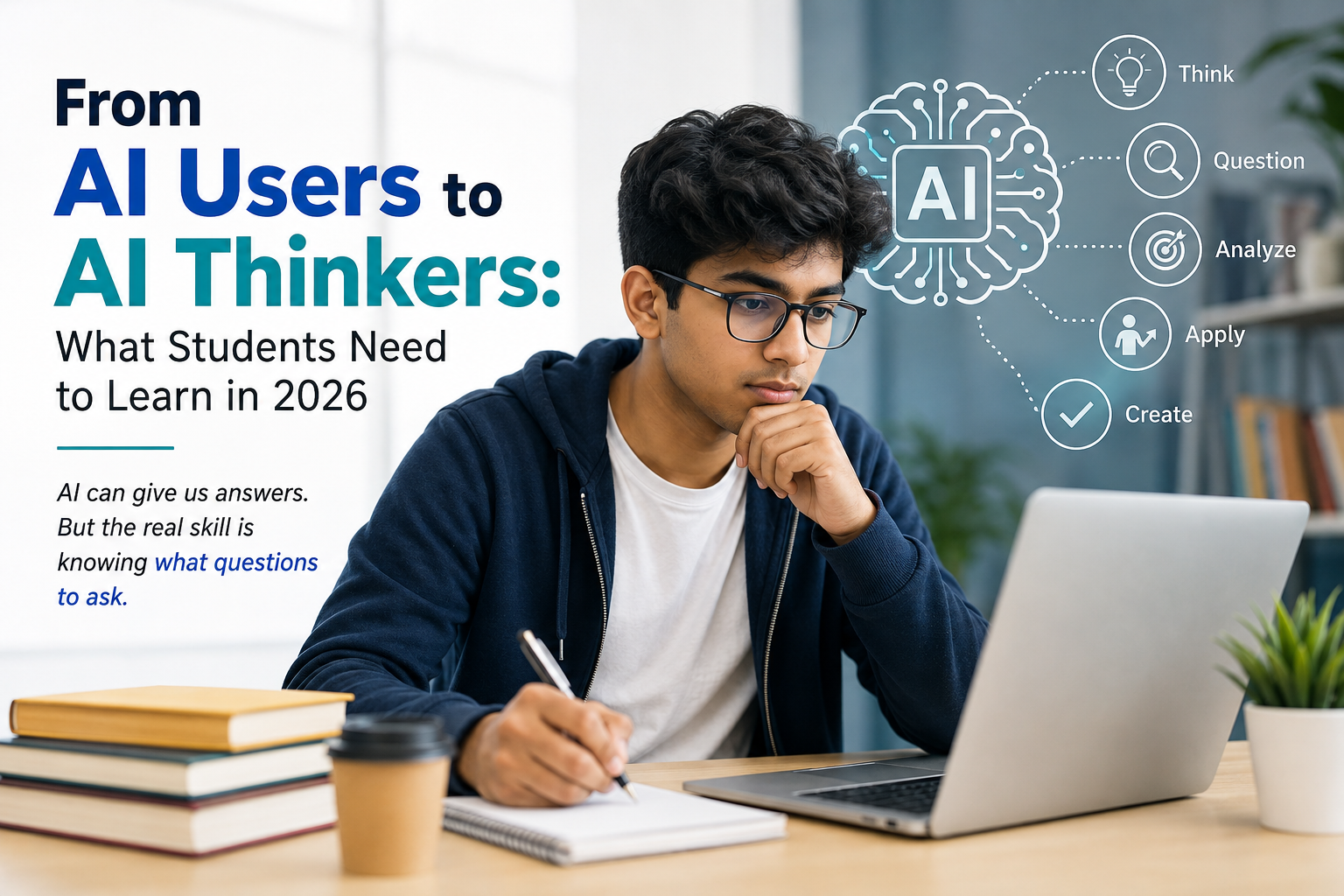
    From AI Users to AI Thinkers: What Students Need to Learn in 2026

    From AI Users to AI Thinkers: What Students Need to Learn in 2026

    From AI Users to AI Thinkers: What Students Need to Learn in 2026

    AI can give us answers. But the real skill is knowing what questions to ask.

    Over the past few years, I have noticed a major change in the way students learn, search for information, complete assignments, and prepare for their careers.

    Earlier, when students had a question, they would search Google, read articles, watch videos, discuss the topic with friends, or ask a teacher.

    Today, there is another option available within seconds — Artificial Intelligence.

    Students can ask AI to explain a concept, write a program, prepare notes, create a presentation, analyse data, generate ideas, and even help them prepare for an interview.

    This is a powerful change.

    But as an educator, I believe we need to ask a more important question:

    Are our students becoming better thinkers, or are they simply becoming better users of AI?

    That is where the real challenge begins.

    AI Is Not the Problem

    I don’t believe that students using AI is a bad thing.

    In fact, I encourage students to explore AI tools.

    AI can make learning more interesting and accessible. A student who does not understand a programming concept can ask for another explanation. A student struggling with mathematics can ask for a step-by-step solution. A student preparing for an interview can practise questions with an AI tool.

    The problem starts when AI becomes a replacement for thinking.

    If a student receives an answer from AI and submits it without understanding it, very little learning has happened.

    If a student asks AI to write an entire program but cannot explain how the program works, the student has completed a task—but has not necessarily developed a skill.

    This distinction is becoming increasingly important.

    From “Give Me the Answer” to “Help Me Understand”

    One of the biggest changes I would like to see in students is a change in the way they ask questions.

    Instead of asking:

    “Write an assignment on Artificial Intelligence.”

    A student could ask:

    “Explain the impact of Artificial Intelligence on employment, give me different viewpoints, and help me develop my own argument.”

    The second approach requires more thinking.

    The student is not simply asking AI to produce content. The student is using AI as a learning partner.

    This is the mindset we need to develop.

    The Question Becomes More Important

    When information was difficult to find, knowing where to search was an important skill.

    Today, information is everywhere.

    AI can summarise it, organise it and present it in seconds.

    So, in my view, the value is shifting from simply finding information to asking meaningful questions and evaluating the answers.

    Students need to learn:

    • What should I ask?

    • Why am I asking it?

    • Is the answer correct?

    • What information is missing?

    • Can I verify it?

    • Do I agree with the answer?

    • Can I explain it in my own words?

    These are not just AI skills.

    They are thinking skills.

    5 Skills Students Should Develop in 2026

    1. AI Literacy

    Students don’t necessarily need to become AI engineers.

    But every student should understand the basics of AI.

    They should know how AI systems are used, what they can do, where they can make mistakes, and why blindly trusting AI-generated information can be risky.

    AI literacy should become part of modern education.

    2. Critical Thinking

    This is perhaps the most important skill.

    AI can produce a very convincing answer—and still be wrong.

    Students therefore need to develop the habit of questioning information.

    “AI said it” is not the same as “it is true.”

    Students should learn to compare sources, verify facts, identify assumptions, and look for evidence.

    3. Problem-Solving

    In the workplace, employees are rarely given a perfectly defined problem.

    They need to understand the situation, identify the actual problem, consider different solutions, and decide what to do.

    AI can help with this process.

    But the human still needs to understand the problem.

    Students should therefore spend more time solving real-world problems instead of only completing textbook exercises.

    4. Communication

    AI can write an email.

    AI can prepare a report.

    AI can create a presentation.

    But students still need to communicate their ideas clearly.

    They need to explain a project to a client.

    They need to discuss an idea with a team.

    They need to answer questions in an interview.

    They need to present their research.

    Good communication will remain a human advantage.

    5. Adaptability

    Technology is changing faster than our traditional curriculum.

    A programming language that is popular today may not have the same importance a few years from now.

    The same applies to AI tools.

    Therefore, students should not focus only on learning one tool.

    They should learn how to learn.

    A student who can adapt, explore new technologies, learn independently, and continuously improve will always have an advantage.

    Coding Is Changing Too

    As someone involved in computer science education, I see this change very clearly.

    Students can now use AI to generate code, identify errors, explain programming concepts, and suggest solutions.

    This does not mean coding is becoming useless.

    I believe the opposite.

    The role of the programmer is changing.

    Students should move beyond simply learning syntax.

    They should understand:

    What problem am I solving?

    Why am I choosing this approach?

    How does the code work?

    What happens if the input changes?

    Is the solution efficient and secure?

    Can I modify it when the requirements change?

    AI may help write the code.

    But students need to understand the logic behind the code.

    That understanding cannot be outsourced completely.

    The Classroom Also Needs to Change

    AI is also forcing educators to rethink the way we teach and assess students.

    If an assignment can be completed by simply copying an AI-generated response, perhaps the assignment itself needs to change.

    Instead of only asking students to write about a topic, we can ask them to:

    • analyse a real dataset,

    • solve a local problem,

    • conduct a small survey,

    • compare two AI-generated answers,

    • identify errors in an AI response,

    • explain their decision-making process,

    • build a small working prototype,

    • present and defend their work.

    These activities make learning more meaningful.

    They also help us understand whether the student actually understands the subject.

    AI Should Support Learning, Not Replace Learning

    For me, this is the central idea.

    I don’t see AI as a replacement for teachers.

    I see it as another tool that can support learning.

    A teacher can provide context, experience, encouragement, feedback and human understanding.

    AI can provide explanations, examples, ideas and assistance.

    When used properly, both can complement each other.

    The goal should not be to keep AI outside the classroom.

    The goal should be to teach students how to use AI responsibly and intelligently.

    What Will Employers Look For?

    The workplace is also changing.

    Employers may not simply ask:

    “Do you know this technology?”

    They may increasingly ask:

    “Can you use technology to solve problems?”

    There is a difference.

    A student may know how to use an AI tool.

    Another student may understand the business problem, use AI appropriately, analyse the result, verify the information and present a practical solution.

    The second student brings much greater value.

    This is why I believe AI fluency, problem-solving, communication, critical thinking and adaptability will become increasingly important for graduates.

    Students Don’t Need to Compete With AI

    I often think students sometimes look at AI as something they need to compete against.

    I don’t think that is the right way to look at it.

    Students should learn to work with AI.

    A calculator did not eliminate mathematics.

    The internet did not eliminate learning.

    Search engines did not eliminate knowledge.

    Similarly, AI does not have to eliminate human thinking.

    But it does require us to think differently.

    The students who learn how to combine their knowledge with AI will have an advantage.

    The Student I Want to See in 2026

    I don’t want to see students who simply know how to generate an AI response.

    I want to see students who can say:

    “This is the problem.”

    “This is what I found.”

    “This is what AI suggested.”

    “I verified the information.”

    “I don’t agree with this part, and here is why.”

    “This is my solution.”

    That, to me, represents an AI thinker.

    From AI Users to AI Thinkers

    The future of education is not about choosing between humans and AI.

    It is about preparing students to become better humans with AI.

    AI can generate.

    AI can analyse.

    AI can recommend.

    AI can automate.

    But students still need to question, understand, decide, create and take responsibility.

    That is why I believe our focus in 2026 should move from producing students who are simply AI users to developing students who are AI thinkers.

    The technology will continue to change.

    The tools will continue to change.

    But the ability to think critically, solve problems, communicate clearly and adapt to change will remain valuable.

    And perhaps the most important lesson we can give our students is this:

    Don’t just ask AI for an answer. Ask AI to help you understand the problem.

    Because the future will not belong only to those who know how to use AI.

    It will belong to those who know how to think with it.
  • The Future of Education: From Classrooms to AI-Powered Learning

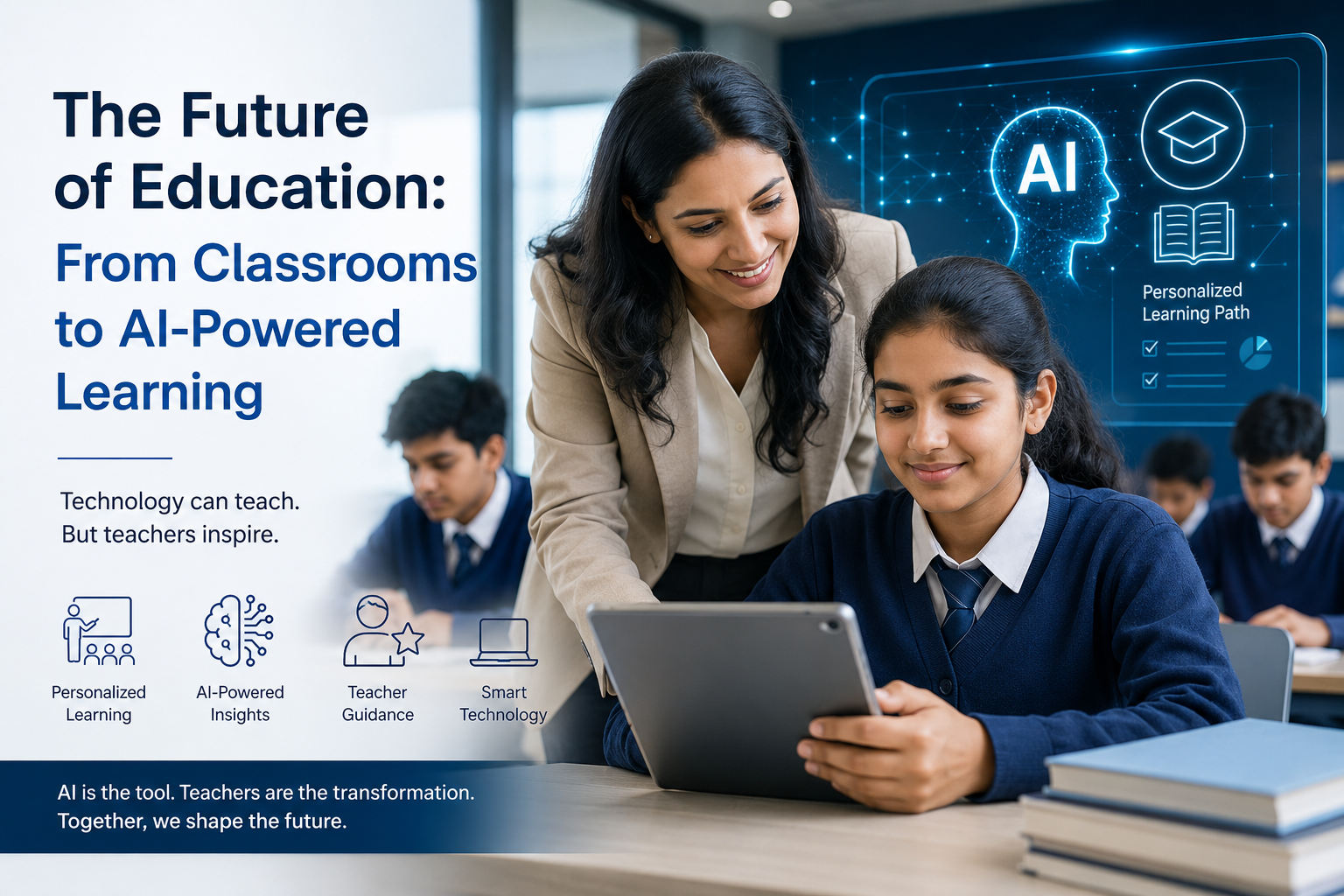
    The Future of Education: From Classrooms to AI-Powered Learning

    The Future of Education: From Classrooms to AI-Powered Learning

    Education has always evolved with society.

    From blackboards to smartboards, from textbooks to online learning platforms, every generation of students has experienced a different way of learning. Today, we are standing at another important turning point — Artificial Intelligence is becoming part of education.

    But the real question is not “Will AI change education?”

    It already is.

    The bigger question is:

    How do we make sure technology improves learning without taking away the human side of education?

    From One Classroom to Individual Learning

    Traditionally, a teacher enters a classroom with one lesson plan for an entire group of students.

    But every student is different.

    One student may understand a concept immediately, while another may need three more examples. Some students learn better through videos, others through practice, discussion or real-world examples.

    AI has the potential to support this difference.

    It can help students practise at their own pace, identify areas where they are struggling and receive explanations in different ways.

    This doesn’t mean replacing the teacher.

    It means giving the teacher better tools to understand and support learners.

    The Teacher’s Role Is Changing

    There is often a fear that AI will replace teachers.

    I believe the opposite can happen.

    As AI takes care of some repetitive tasks — generating practice questions, analysing learning patterns, preparing basic content or providing instant feedback — teachers can spend more time on what technology cannot easily replace:

    mentoring, motivating, questioning, listening and understanding students.

    A teacher is not simply someone who delivers information.

    A good teacher helps a student believe:

    “I can do this.”

    That human connection will remain extremely important, even in an AI-powered classroom.

    Students Need More Than AI Tools

    There is another challenge.

    If students use AI only to get quick answers, education could actually become weaker.

    The goal should not be to create students who know how to ask AI for answers.

    The goal should be to create students who know how to:

    • Ask meaningful questions

    • Think critically

    • Verify information

    • Solve problems

    • Work creatively

    • Communicate effectively

    • Use AI responsibly

    In other words, AI literacy must become part of modern education.

    The Classroom Will Not Disappear

    I don’t think the future of education is a choice between a teacher and a computer.

    It is more likely to be a combination of both.

    Imagine a classroom where AI helps a teacher understand individual learning gaps, while the teacher uses that information to guide students personally.

    Imagine students working on real-world projects, using AI as an assistant while learning to question its answers.

    Imagine assessments focusing less on memorising information and more on problem-solving, creativity and application.

    That is the kind of transformation worth pursuing.

    Technology Should Serve Education — Not Define It

    We should not introduce AI into education simply because it is the latest technology.

    The important question should always be:

    Does this technology help students learn better?

    If the answer is yes, we should embrace it.

    If it creates dependency, reduces critical thinking or removes meaningful human interaction, we need to rethink how we use it.

    The future classroom may look very different from the classroom we grew up in.

    But one thing should remain unchanged:

    At the heart of education is a human being trying to learn, and another human being helping them grow.

    AI can make education smarter.

    But teachers make education meaningful.

    And perhaps the future of education is not classroom versus AI.

    It is classroom + teacher + student + AI — working together.

  • From Screen Time to Skill Time: Rethinking Education for the Gen Z Learner

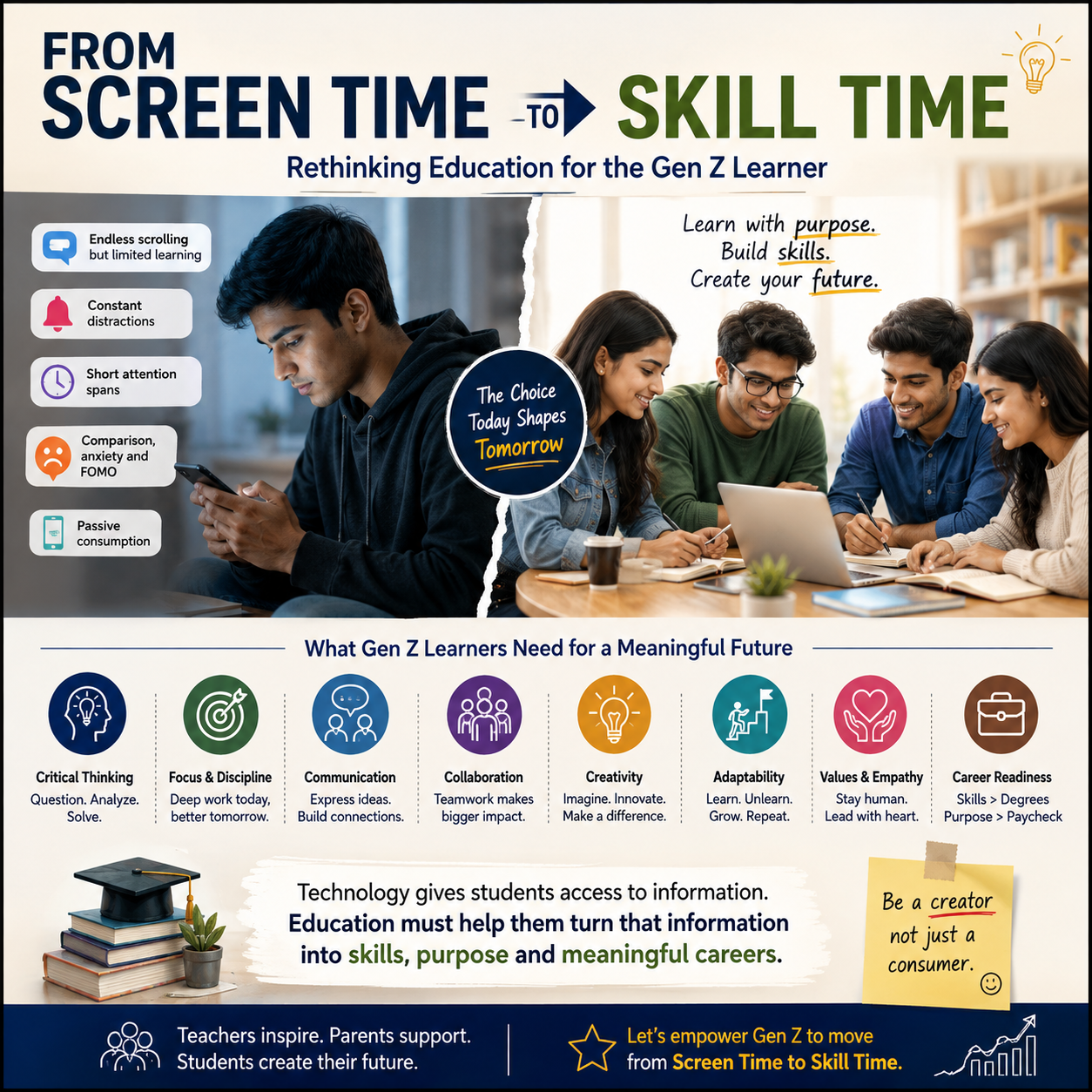
    From Screen Time to Skill Time: Rethinking Education for the Gen Z Learner

    screen Time

     Gen Z, Smartphones & Education: Are We Preparing Students for Life—or Just for Exams?

    Walk into a college classroom today and you will notice something very different from a decade ago.

    A smartphone is almost always within reach.

    For Gen Z, the mobile phone is not just a device. It is a classroom, library, entertainment centre, social space, career platform and sometimes even a source of emotional support.

    The question is not:

    “Should students use smartphones?”

    The real question is:

    “Are we teaching students how to use them wisely?”

    A student can watch a YouTube tutorial in seconds, learn a programming language through an AI tool, explore careers on LinkedIn, build a portfolio on GitHub and access courses from universities around the world.

    Yet, at the same time, we are seeing another challenge:

    Information is increasing, but attention is decreasing.

    Students are surrounded by opportunities, but many are uncertain about their career direction.

    They have AI tools, but may struggle to think independently.

    They can access thousands of courses, but don’t always know what to learn, why to learn it, and how to demonstrate those skills.

    This is where education needs to evolve.

    The classroom should not compete with the smartphone.

    It should teach students what the smartphone cannot:

    • How to think critically
    • How to communicate effectively
    • How to solve real problems
    • How to work with people
    • How to handle failure
    • How to make responsible decisions
    • How to build a meaningful career—not just get a job

    And perhaps most importantly, students need to understand:

    Your degree may open the door, but your skills, attitude, adaptability and ability to keep learning will determine how far you go.

    As educators, our role is therefore changing.

    We are not simply transferring knowledge anymore.

    We are helping young people navigate an overwhelming world of information, technology and career choices.

    Gen Z does not need fewer technologies.

    They need better guidance on how to use technology without allowing technology to use them.

    The future of education is therefore not Teacher vs Technology.

    It is:

    Teacher + Student + Technology + Human Values.

    That, in my view, is the education we need for Viksit Bharat 2047. 

    What do you think? Are smartphones helping our students learn—or making it harder for them to focus?

    #Education #GenZ #Students #HigherEducation #FutureOfWork #CareerReadiness #DigitalEducation #AIinEducation #Skills #Teachers #ViksitBharat2047 #Technology #HumanValues

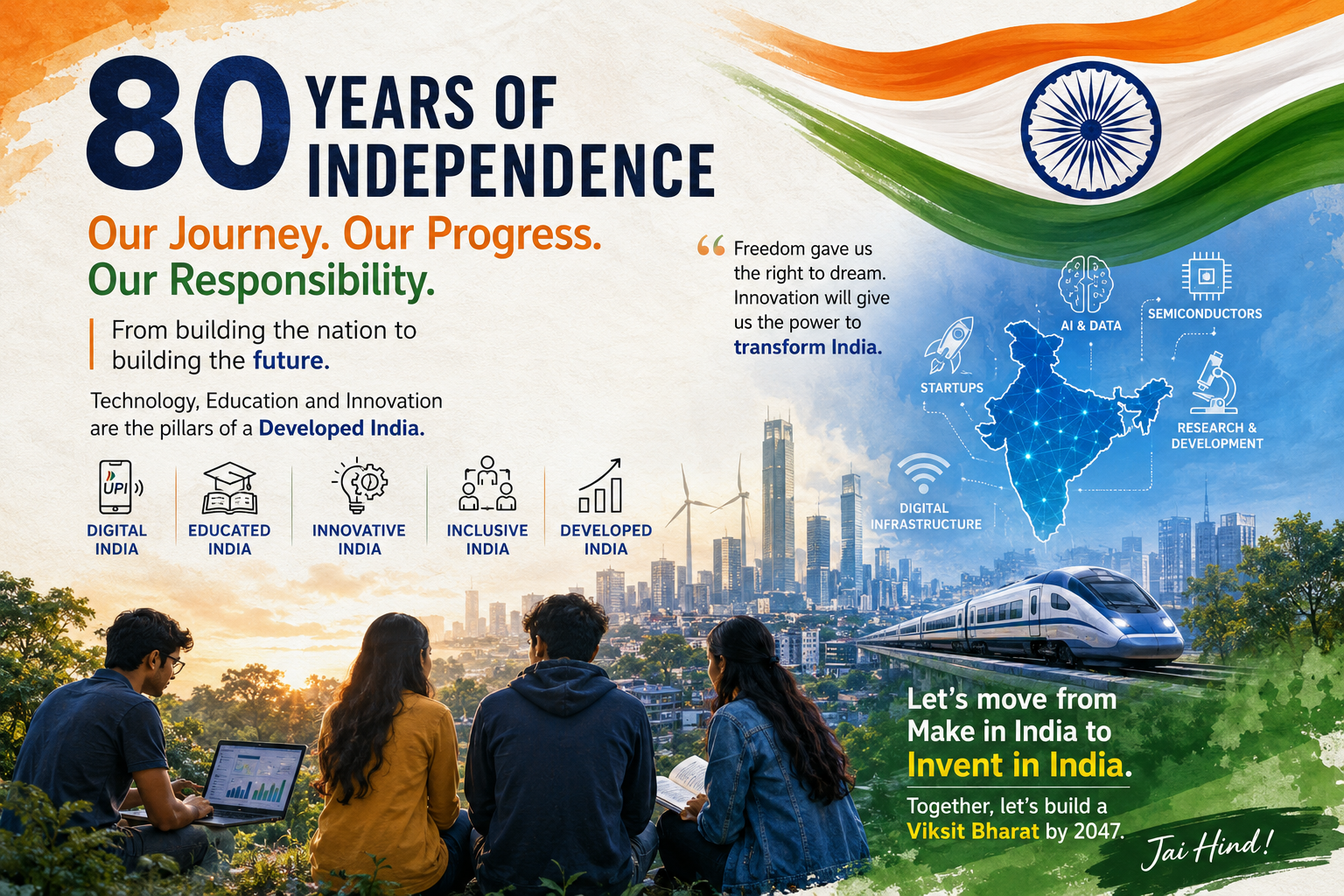
  • 80 Years of Independence: Are We Truly Becoming a Developed India? — My Perspective

    80 Years of Independence: Are We Truly Becoming a Developed India? — My Perspective

    screen Time

     Gen Z, Smartphones & Education: Are We Preparing Students for Life—or Just for Exams?

    Walk into a college classroom today and you will notice something very different from a decade ago.

    A smartphone is almost always within reach.

    For Gen Z, the mobile phone is not just a device. It is a classroom, library, entertainment centre, social space, career platform and sometimes even a source of emotional support.

    The question is not:

    “Should students use smartphones?”

    The real question is:

    “Are we teaching students how to use them wisely?”

    A student can watch a YouTube tutorial in seconds, learn a programming language through an AI tool, explore careers on LinkedIn, build a portfolio on GitHub and access courses from universities around the world.

    Yet, at the same time, we are seeing another challenge:

    Information is increasing, but attention is decreasing.

    Students are surrounded by opportunities, but many are uncertain about their career direction.

    They have AI tools, but may struggle to think independently.

    They can access thousands of courses, but don’t always know what to learn, why to learn it, and how to demonstrate those skills.

    This is where education needs to evolve.

    The classroom should not compete with the smartphone.

    It should teach students what the smartphone cannot:

    • How to think critically
    • How to communicate effectively
    • How to solve real problems
    • How to work with people
    • How to handle failure
    • How to make responsible decisions
    • How to build a meaningful career—not just get a job

    And perhaps most importantly, students need to understand:

    Your degree may open the door, but your skills, attitude, adaptability and ability to keep learning will determine how far you go.

    As educators, our role is therefore changing.

    We are not simply transferring knowledge anymore.

    We are helping young people navigate an overwhelming world of information, technology and career choices.

    Gen Z does not need fewer technologies.

    They need better guidance on how to use technology without allowing technology to use them.

    The future of education is therefore not Teacher vs Technology.

    It is:

    Teacher + Student + Technology + Human Values.

    That, in my view, is the education we need for Viksit Bharat 2047. 

    What do you think? Are smartphones helping our students learn—or making it harder for them to focus?

    #Education #GenZ #Students #HigherEducation #FutureOfWork #CareerReadiness #DigitalEducation #AIinEducation #Skills #Teachers #ViksitBharat2047 #Technology #HumanValues

  • Microsoft Copilot and the Changing Nature of Data Analytics: My Perspective

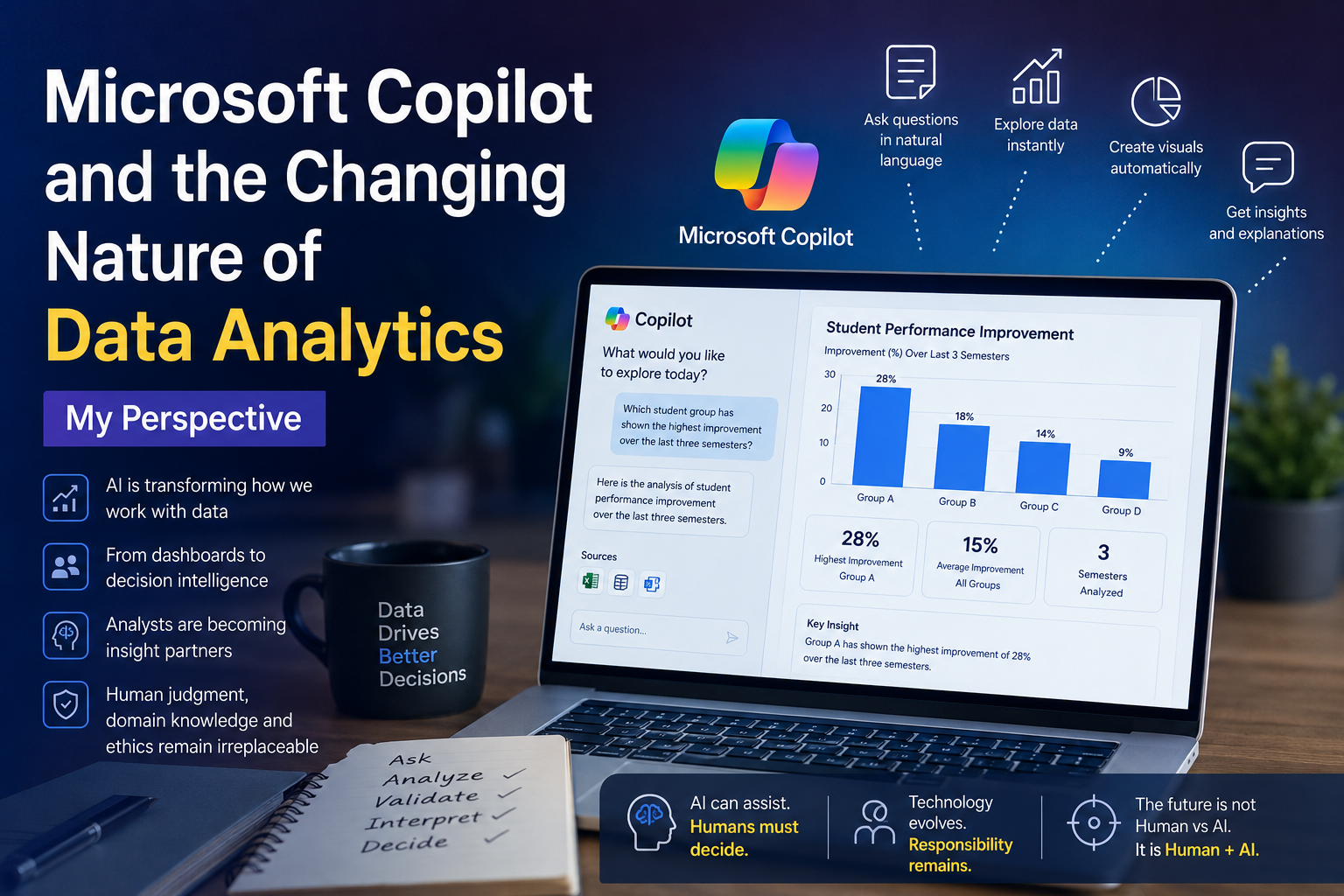
    Microsoft Copilot and the Changing Nature of Data Analytics: My Perspective

    Copilot

    Microsoft Copilot and the Changing Nature of Data Analytics: My Perspective

    Data analytics is undergoing a significant transformation.

    For many years, the work of a data analyst involved collecting data, cleaning datasets, writing queries, creating calculations, developing dashboards, identifying patterns, and finally communicating insights to decision-makers.

    Today, Artificial Intelligence is changing almost every stage of this process.

    One technology that I find particularly interesting in this transformation is Microsoft Copilot.

    From my perspective as an educator and researcher working with Data Science, AI, Machine Learning and analytics, Copilot is not simply another productivity tool. It represents a shift in the way people interact with data.

    From “How do I analyse this?” to “What do I want to know?”

    Traditionally, analysts needed to understand technical processes before reaching meaningful insights.

    For example, a user might need to know:

    • How to write a SQL query

    • How to create a DAX measure

    • How to transform data

    • How to select an appropriate visualization

    • How to interpret statistical results

    AI-assisted analytics is changing this interaction.

    A user can increasingly begin with a natural-language question such as:

    “Which student group has shown the highest improvement over the last three semesters?”

    or

    “Which product category contributed most to the decline in sales?”

    The system can assist in identifying relevant data, generating calculations, suggesting visualizations and explaining patterns.

    This makes analytics more accessible to people who may not have advanced programming or statistical skills.

    But does this mean analysts are becoming less important?

    I don’t think so.

    I believe the role of the analyst is changing rather than disappearing.

    The most important skill of the future analyst may not be simply knowing how to create a chart or write a formula.

    It will be the ability to ask the right questions.

    An AI system can help generate a visualization, but the analyst must determine:

    Is this the right visualization?

    AI can identify a correlation, but the analyst must ask:

    Does this correlation actually make sense in the real-world context?

    AI can generate an insight, but the analyst must determine:

    Can this insight be trusted and used for decision-making?

    This is where domain knowledge, critical thinking and analytical reasoning remain extremely important.

    From Dashboard Developer to Insight Partner

    I see an important shift happening here.

    The traditional analyst was often expected to produce reports and dashboards.

    The emerging analyst is increasingly expected to become an insight partner.

    Instead of simply answering:

    “What happened?”

    the analyst should help organizations understand:

    “Why did it happen?”

    “What could happen next?”

    “What should we do about it?”

    This takes analytics from reporting toward decision intelligence.

    Tools such as Microsoft Copilot can accelerate this transition by reducing the amount of time spent on repetitive technical tasks.

    Copilot can increase productivity—but it cannot replace responsibility

    One of the biggest advantages of AI-assisted analytics is productivity.

    Tasks that previously required considerable time can potentially be accelerated:

    Data → Query → Calculation → Visualization → Explanation → Insight

    However, there is an important caution.

    AI-generated results should not automatically be considered correct.

    A generated formula may be technically valid but conceptually wrong.

    A visualization may look impressive but communicate a misleading message.

    An AI-generated explanation may sound convincing while overlooking an important variable.

    Therefore, human validation remains essential.

    This is particularly important when analytics is used in areas such as education, finance, healthcare, employment or public policy.

    The importance of Data Literacy

    Another major change I see is the growing importance of data literacy.

    Previously, organizations often divided people into two groups:

    Technical people – who worked with data.

    Non-technical people – who consumed reports.

    AI-assisted analytics is gradually reducing this gap.

    Business users, teachers, researchers, managers and students can increasingly interact with data using natural language.

    But accessibility does not automatically create understanding.

    A person still needs to understand concepts such as:

    • Data quality

    • Bias

    • Correlation vs causation

    • Sampling

    • Statistical significance

    • Data privacy

    • Model limitations

    • Visualization principles

    Therefore, I believe that AI literacy and data literacy must develop together.

    What does this mean for students?

    As an educator, this is perhaps the area I find most interesting.

    Students learning Data Science today should not focus only on memorizing syntax.

    Learning Python, SQL, Power BI, statistics and Machine Learning remains important.

    But students should also learn how to:

    Ask better questions.

    Evaluate AI-generated answers.

    Interpret data critically.

    Validate analytical results.

    Communicate insights clearly.

    Understand ethical implications.

    The future data professional will need a combination of technical skills + analytical thinking + domain knowledge + AI literacy.

    My Perspective

    I don’t see Microsoft Copilot as a replacement for the data analyst.

    I see it as a co-pilot for the analyst.

    The word “Copilot” itself gives an interesting perspective.

    A copilot assists with navigation, but the pilot remains responsible for the journey.

    Similarly, AI can assist us with data exploration, calculations, visualizations and explanations.

    But humans must remain responsible for the questions we ask, the decisions we make and the consequences of those decisions.

    The real competitive advantage will therefore not come from simply knowing how to use Copilot.

    It will come from knowing when to use it, how to question it, how to validate it, and how to turn its output into meaningful decisions.

    The Future of Data Analytics

    I believe the future of analytics will not be:

    Human vs AI

    It will increasingly be:

    Human + AI

    The analysts who embrace AI while strengthening their statistical thinking, domain expertise, communication skills and ethical judgment will be better positioned for the future.

    For me, the most exciting question is no longer:

    “Can AI analyse data?”

    It is:

    “What better decisions can humans make when AI helps them understand data more effectively?”

    That is where I believe the next chapter of data analytics is beginning.

  • Data Science in Everyday Life: Beyond Numbers

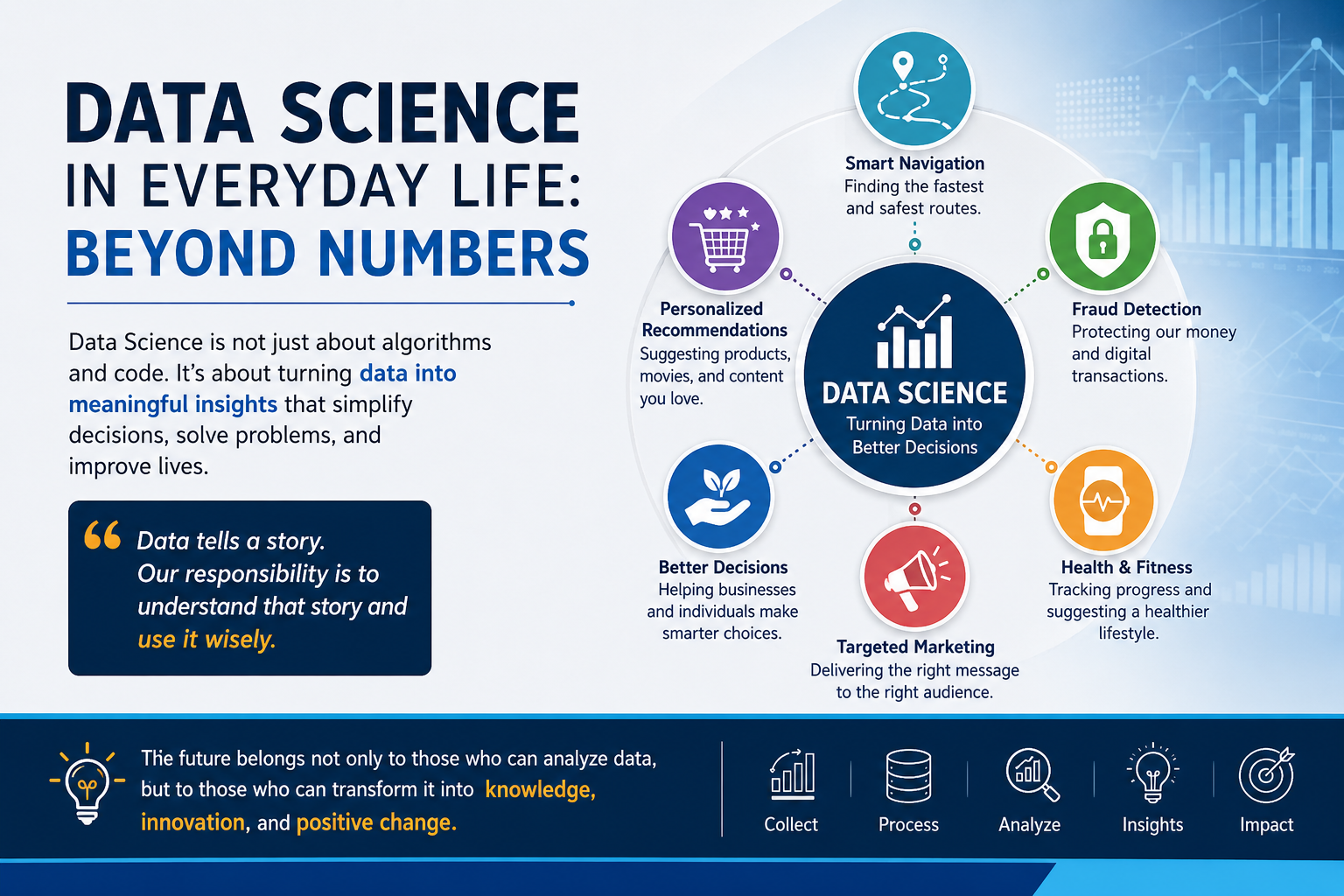
    Data Science in Everyday Life: Beyond Numbers

    Data Science in Everyday Life: Beyond Numbers

    When people hear the term Data Science, they often think of complex algorithms, coding, machine learning models, or dashboards filled with charts. But the real power of Data Science goes far beyond numbers.

    Every day, whether we realize it or not, data shapes the decisions we make.

    The route suggested by Google Maps, the recommendations on Netflix or Amazon, fraud detection in banking, personalized healthcare, weather forecasts, online learning platforms, and even the content we see on social media—all of these are powered by data-driven intelligence.

    To me, Data Science is not just about analyzing data; it’s about understanding human behavior, identifying patterns, solving real-world problems, and making informed decisions.

    As an educator, I believe our responsibility is not only to teach programming languages or statistical techniques but also to help students develop a data-driven mindset. Learning how to ask the right questions, interpret information critically, and transform raw data into meaningful insights has become an essential skill in today’s AI-driven world.

    In the age of Artificial Intelligence, data is the foundation. AI can only be as intelligent as the quality of the data it learns from. Clean data, ethical practices, domain knowledge, and thoughtful interpretation are just as important as sophisticated algorithms.

    Data Science is no longer limited to researchers or IT professionals. It is becoming a core competency across healthcare, education, finance, agriculture, manufacturing, marketing, public administration, and countless other fields. Every profession is evolving into a data-informed profession.

    The future belongs to those who can combine analytical thinking, domain expertise, and ethical use of AI to create solutions that positively impact society.

    Let’s move beyond seeing Data Science as a collection of numbers and code. Instead, let’s recognize it as a powerful tool for innovation, informed decision-making, and meaningful change.

    Data tells us what happened. Analytics explains why. Artificial Intelligence predicts what could happen next. Human wisdom decides what should happen.

    What are your thoughts? How has Data Science influenced your profession or daily life? I’d love to hear your perspective.

    #DataScience #ArtificialIntelligence #MachineLearning #Analytics #Education #HigherEducation #DigitalTransformation #Innovation #AI #Python #DataDriven #Learning #Technology #FutureSkills

  • My Journey with R Programming in the Age of AI

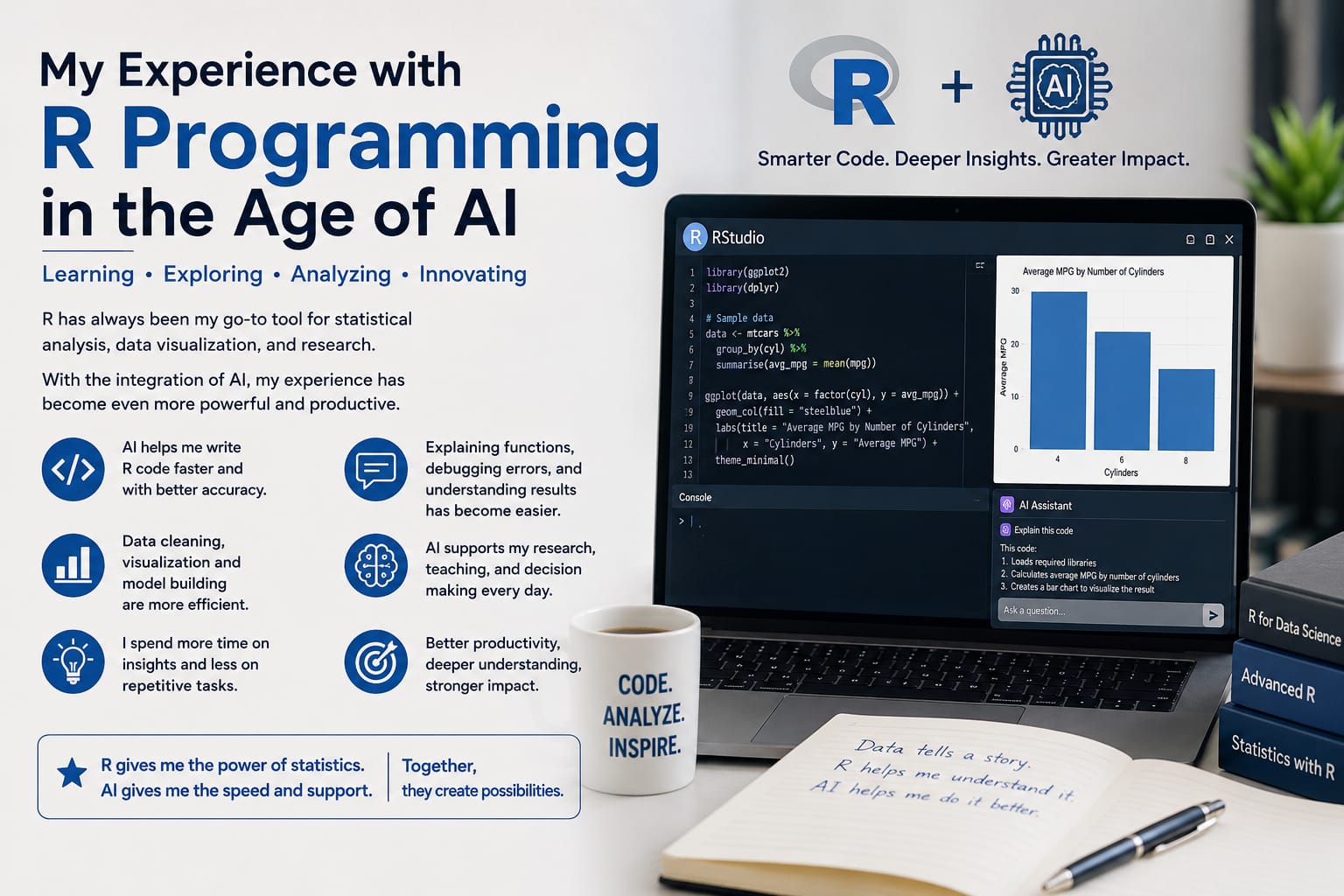
    My Journey with R Programming in the Age of AI

    My Journey with R Programming in the Age of AI

    As an educator, researcher, and someone passionate about data analytics, I have always believed that learning never stops. Over the years, I have worked with different programming languages and analytical tools, but R has consistently been one of my favourites for statistical computing, data visualization, and research.

    Recently, I started exploring how Artificial Intelligence (AI) can complement the R programming workflow. Like many others, I was curious to know whether AI would change the way we write code, analyze data, and conduct research. After spending time experimenting with AI-powered tools alongside R, I can confidently say that it has transformed the way I work—not by replacing my skills,but by enhancing them.

    One of the first things I noticed was how much time AI saves during development. Whether I need help writing a function, debugging an error, cleaning a dataset, or generating a visualization using ggplot2, AI acts like a knowledgeable assistant that is available whenever I need it. Instead of spending hours searching documentation or forums, I can focus more on understanding the problem and interpreting the results.

    As a researcher, I find this particularly valuable. Research is not just about writing code; it is about asking the right questions, selecting the correct statistical methods, validating findings, and presenting meaningful conclusions. AI helps reduce the time spent on repetitive tasks, allowing me to devote more attention to critical thinking and decision-making.

    Teaching has also become more engaging. When students encounter errors or struggle with R syntax, AI enables them to understand concepts more quickly. However, I always remind my students that AI should be viewed as a learning companion rather than a shortcut. The real value lies in understanding why the code works, not simply copying and pasting it.

    One important realization from my experience is that R itself has not changed—our way of working with R has evolved. The language remains as powerful as ever for statistical analysis, predictive modelling, machine learning, and data visualization. What has changed is that AI now helps us become more productive, efficient, and confident in using these capabilities.

    As technology continues to evolve, I believe that professionals who combine strong analytical skills with AI-assisted tools will be better prepared for the future. Programming is no longer just about writing code—it is about solving problems, extracting insights from data, and making informed decisions.

    My journey with R and AI is still ongoing, and every day brings something new to learn. That is what excites me the most. Technology will continue to evolve, but curiosity, continuous learning, and the willingness to adapt will always remain our greatest strengths.

    I look forward to exploring more possibilities where R and AI work together to make research, teaching, and data analytics more impactful. If you are learning R or working in data science, I encourage you to embrace AI—not as a replacement for your expertise, but as a partner that helps you learn faster, think deeper, and innovate with confidence.

    What has your experience been with R and AI? I would love to hear your thoughts and learn from your journey as well.

  • Data Cleaning: The Most Important Step Nobody Talks About

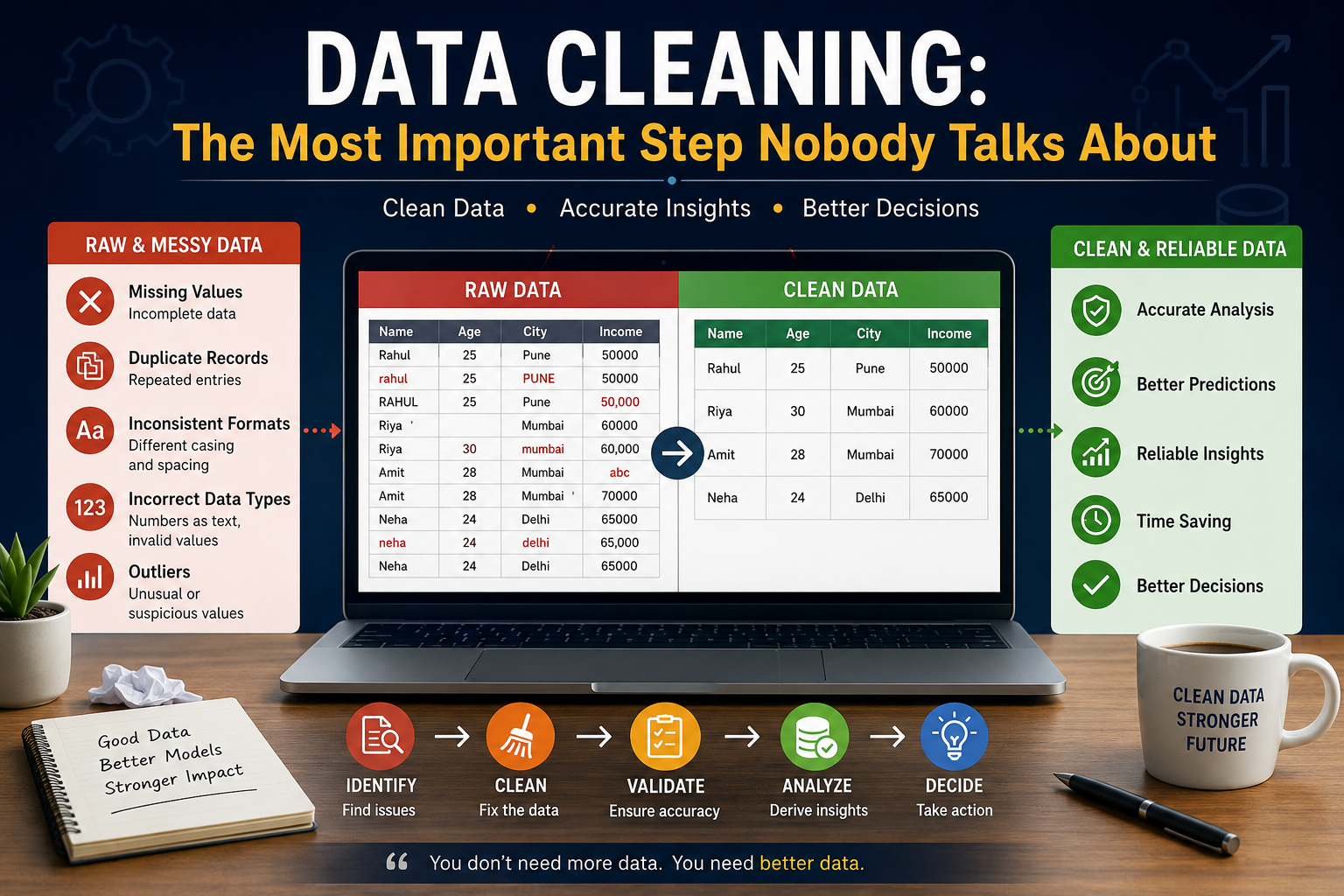
    Data Cleaning: The Most Important Step Nobody Talks About

    Data Cleaning: The Most Important Step Nobody Talks About

    “Everyone wants to build intelligent AI models. Very few people realize that intelligence begins with clean data.”

    When we hear terms like Artificial Intelligence, Machine Learning, or Data Science, our minds immediately jump to powerful algorithms, predictive models, and futuristic technologies. We often celebrate the final outcome—a model that predicts customer behavior, identifies diseases, or recommends the perfect movie.

    But there’s an important part of the journey that rarely makes headlines.

    It’s called data cleaning.

    It isn’t glamorous. It doesn’t involve complex mathematics or advanced AI models. Yet, it is one of the most valuable skills every data professional should master. In fact, the success of any analytics or AI project often depends more on the quality of the data than on the sophistication of the algorithm.

    Simply put, clean data creates trustworthy insights.

    Why Data Cleaning Deserves More Attention

    Imagine you’re baking a cake.

    You buy the finest ingredients, use the latest kitchen equipment, and carefully follow every step of the recipe. But what if the flour is stale or the sugar has been mixed with salt?

    No matter how skilled you are, the final result won’t meet expectations.

    Working with data is no different.

    No machine learning model—not even the most advanced one—can consistently produce reliable results if the underlying data is incomplete, inaccurate, or inconsistent.

    That’s why experienced data scientists often repeat a simple but powerful phrase:

    “Garbage in, garbage out.”

    If poor-quality data goes into your system, poor-quality decisions will come out.

    What Exactly Is Data Cleaning?

    Data cleaning is the process of preparing raw data so it becomes accurate, consistent, complete, and ready for analysis.

    Think of it as giving your data a health check.

    During this process, you identify and fix problems such as:

    • Missing information
    • Duplicate records
    • Typographical mistakes
    • Inconsistent formats
    • Incorrect values
    • Irrelevant data
    • Unusual or suspicious entries

    The objective isn’t just to make data look neat. It’s to ensure that every decision made from that data is based on facts you can trust.

    A Lesson Every Beginner Learns

    When students begin learning Data Science, they’re usually excited to build machine learning models.

    The first question is often:

    “Which algorithm should I use?”

    Interestingly, experienced professionals ask a different question:

    “How clean is your data?”

    That single question often determines whether a project succeeds or struggles.

    A beautifully designed model trained on poor-quality data will almost always perform worse than a simple model trained on clean, reliable information.

    A Real-Life Example

    Imagine a college wants to predict which students may need additional academic support.

    The dataset contains attendance records, internal assessment marks, and assignment scores.

    At first glance, everything seems fine.

    But a closer look reveals several issues:

    • Some students appear more than once.
    • Attendance values are missing for several records.
    • Names are entered differently, such as “Rahul”, “RAHUL”, and “Rahul Kumar”.
    • Marks have been entered using different grading formats.

    If these problems aren’t addressed before building the prediction model, the results may be misleading. Students who genuinely need support could be overlooked, while others may be incorrectly identified.

    This is why data cleaning isn’t just a technical task—it has real-world consequences.

    Common Data Problems You Will Encounter

    No dataset is perfect. Whether you’re working in education, healthcare, finance, or business, you’ll likely encounter familiar challenges.

    Missing Values

    Sometimes information simply isn’t available.

    A customer’s age may be blank, a student’s attendance may be missing, or a survey participant may skip a question.

    These gaps need thoughtful handling rather than being ignored.

    Duplicate Records

    The same person or transaction may appear multiple times.

    If duplicates remain, reports become inaccurate and machine learning models may learn the wrong patterns.

    Inconsistent Formatting

    People rarely enter data in exactly the same way.

    One person writes “Goa”, another writes “GOA”, while someone else types “goa”.

    Although they refer to the same place, a computer may treat them as completely different values.

    Incorrect Data Types

    Dates, numbers, and text are often stored in inconsistent formats.

    These seemingly small issues can lead to major processing errors later.

    Outliers

    Occasionally, you’ll find values that simply don’t make sense.

    For example, if a student studies 5 hours per day on average, an entry showing 150 study hours deserves investigation before it’s accepted as truth.

    Data Cleaning Is an Investment, Not a Delay

    Many people assume data cleaning slows down a project.

    The opposite is usually true.

    Spending extra time preparing your data saves countless hours later by reducing errors, improving model accuracy, and increasing confidence in the final results.

    It also builds trust among stakeholders who rely on your analysis to make important decisions.

    ools That Make Data Cleaning Easier

    Fortunately, you don’t need expensive software to improve data quality.

    Professionals commonly use:

    • Microsoft Excel for smaller datasets
    • Python (Pandas) for automation and large-scale analysis
    • SQL for database management
    • Power BI (Power Query) for business reporting
    • OpenRefine for messy textual data
    • R for statistical analysis

    The choice of tool matters less than the commitment to maintaining high-quality data.

    The Human Side of Data Science

    Data Science isn’t only about writing code.

    It’s about understanding people, solving problems, and making informed decisions.

    Every dataset represents real individuals, businesses, patients, students, or customers. When we clean data carefully, we’re respecting the stories behind those numbers.

    Good data practices ultimately lead to better services, smarter decisions, and more meaningful outcomes.

    Final Thoughts

    Artificial Intelligence may be transforming the future, but its success still depends on something remarkably simple—clean, trustworthy data.

    Before celebrating a highly accurate prediction or an impressive dashboard, ask yourself one important question:

    “Can I trust the data behind it?”

    Because in the world of Data Science, success doesn’t begin with algorithms.

    It begins with quality.

    And quality always begins with clean data.

  • The Most Valuable Skill in 2030 Won’t Be Coding—It Will Be Adaptability

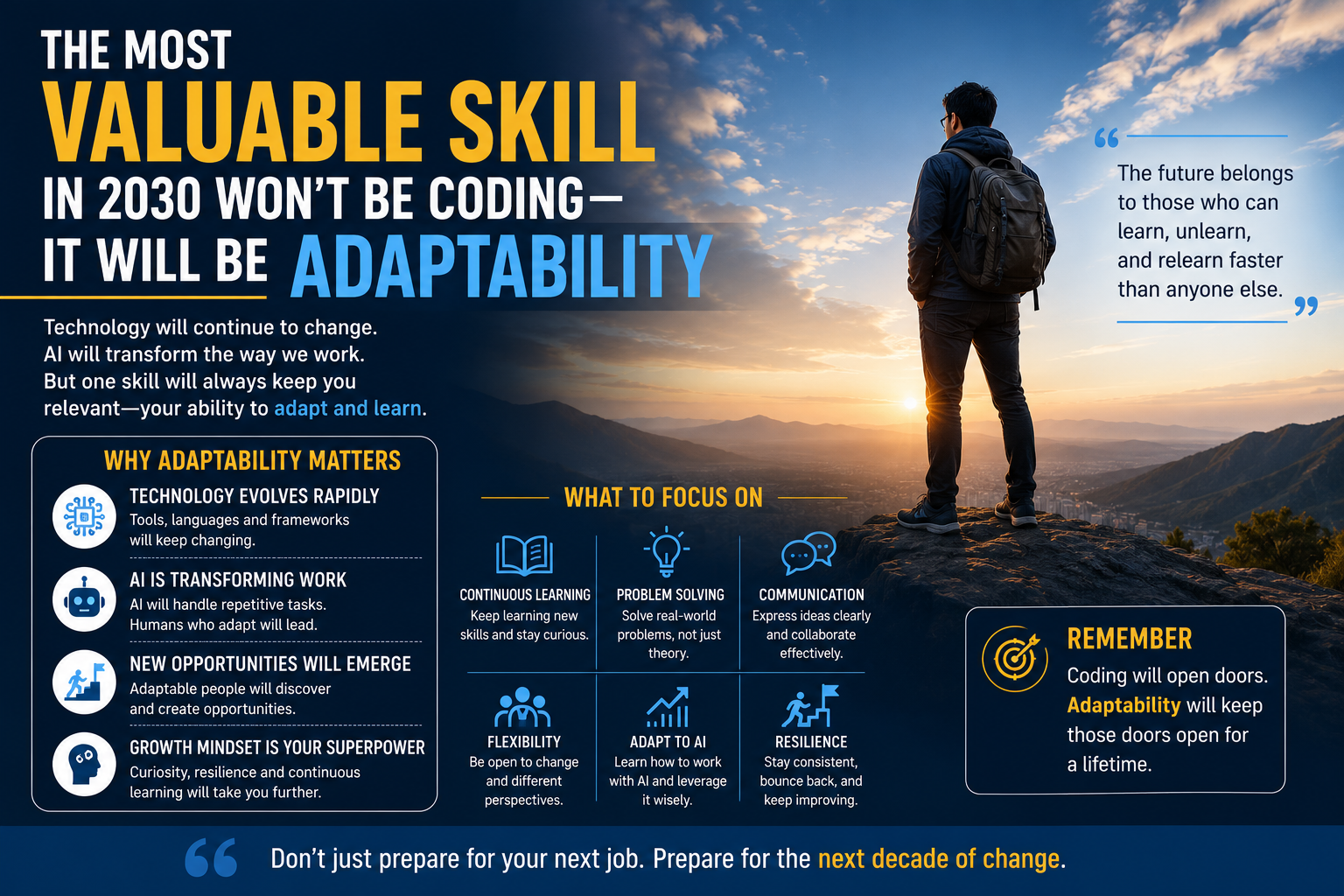
    The Most Valuable Skill in 2030 Won’t Be Coding—It Will Be Adaptability

    The Most Valuable Skill in 2030 Won’t Be Coding—It Will Be Adaptability

    For years, students have asked me a familiar question:

    “Sir, which programming language should I learn to secure a good career?”

    A decade ago, my answer might have been Java.

    A few years later, it could have been Python.

    Today, many expect me to say Artificial Intelligence or Prompt Engineering.

    But my answer has changed.

    The most valuable skill in 2030 won’t be coding. It will be adaptability.

    Before anyone misunderstands me, let me be clear—I am not saying coding is becoming unimportant. As a Computer Science educator, I know programming will continue to be one of the foundations of technology.

    What I am saying is this:

    Programming languages will change. Frameworks will evolve. AI tools will become smarter. But the ability to learn, adapt, and grow will remain the most valuable skill of all.

    Technology Has Never Stood Still

    When I began my journey in technology, software development looked very different from what it does today.

    We moved from desktop applications to web applications.

    From static HTML pages to dynamic web frameworks.

    From procedural programming to object-oriented design.

    From traditional mobile development to Flutter and Jetpack Compose.

    From local servers to cloud computing.

    Today, we are working alongside Artificial Intelligence.

    Every few years, the technologies change.

    What remains constant is the need to keep learning.

    Looking back, I realise that the professionals who succeeded weren’t always the ones who knew the latest programming language.

    They were the ones who embraced change instead of fearing it.

    Knowledge Has an Expiry Date

    This is perhaps one of the biggest lessons every student should understand.

    Technical knowledge has a shelf life.

    The language you master today may become less relevant tomorrow.

    The framework that dominates the industry today may be replaced within a few years.

    Even AI tools that seem revolutionary today will evolve rapidly.

    If your identity is built around a single technology, your career becomes vulnerable.

    If your identity is built around learning, your opportunities become limitless.

    Coding Teaches Logic. Adaptability Builds Careers.

    Learning programming develops analytical thinking, logical reasoning, and problem-solving abilities.

    Those skills will always matter.

    However, the workplace of 2030 will demand something more.

    Employers will value professionals who can:

    • Learn new technologies quickly.
    • Work effectively with AI tools.
    • Solve unfamiliar problems.
    • Collaborate across different domains.
    • Think critically instead of relying blindly on technology.
    • Communicate ideas clearly.
    • Continue learning throughout their careers.

    In other words, they will value people who are adaptable.

    AI Is Changing the Nature of Work

    Artificial Intelligence can now generate code, write reports, analyse data, design presentations, and even explain complex concepts.

    Naturally, many students worry.

    “Will there still be opportunities for us?”

    I believe the answer is yes—but the opportunities will look different.

    AI is automating repetitive tasks.

    That means human value shifts toward creativity, judgment, decision-making, ethics, leadership, and continuous learning.

    Instead of competing with AI, professionals will increasingly work alongside it.

    The question will no longer be:

    “Can you write code?”

    It will become:

    “Can you solve problems, learn quickly, and use technology responsibly?”

    The Career of the Future Belongs to Continuous Learners

    One observation has remained consistent throughout my teaching career.

    The students who perform best in the long run are rarely those who memorise the most.

    They are the students who stay curious.

    They ask questions.

    They experiment.

    They make mistakes.

    They improve.

    They never stop learning.

    Those habits matter far more than mastering a single programming language.

    Education Must Also Adapt

    If industries are evolving, education cannot remain unchanged.

    As educators, our responsibility is no longer limited to completing a syllabus.

    We must prepare students for careers that may not even exist today.

    That means encouraging:

    • Project-based learning.
    • Practical problem-solving.
    • AI literacy.
    • Communication skills.
    • Teamwork.
    • Innovation.
    • Entrepreneurial thinking.
    • Lifelong learning.

    Education should not simply prepare students for their first job.

    It should prepare them for the next twenty years of change.

    My Message to Students

    Don’t chase every new technology simply because it is trending.

    Instead, build strong fundamentals.

    Learn programming.

    Understand databases.

    Develop logical thinking.

    Strengthen communication.

    Learn how AI works.

    Most importantly, develop the confidence to learn something completely new whenever the situation demands it.

    That confidence is adaptability.

    Final Thoughts

    The future doesn’t belong to the person who knows one programming language perfectly.

    It belongs to the person who can learn the next one with confidence.

    Technology will continue to evolve.

    Artificial Intelligence will continue to transform industries.

    New careers will emerge, while others will disappear.

    But one quality will continue to separate successful professionals from everyone else:

    The willingness to adapt.

    As I often tell my students, your degree may help you get your first opportunity, your technical skills may help you perform well, but your adaptability will determine how far you go in your career.

    In the end, careers are not built by resisting change.

    They are built by learning, evolving, and embracing it.

    Because in 2030, the greatest competitive advantage won’t simply be what you know—it will be how quickly you can learn what comes next.

  • Why Prompt Engineering is Becoming a Core Skill for Every Graduate

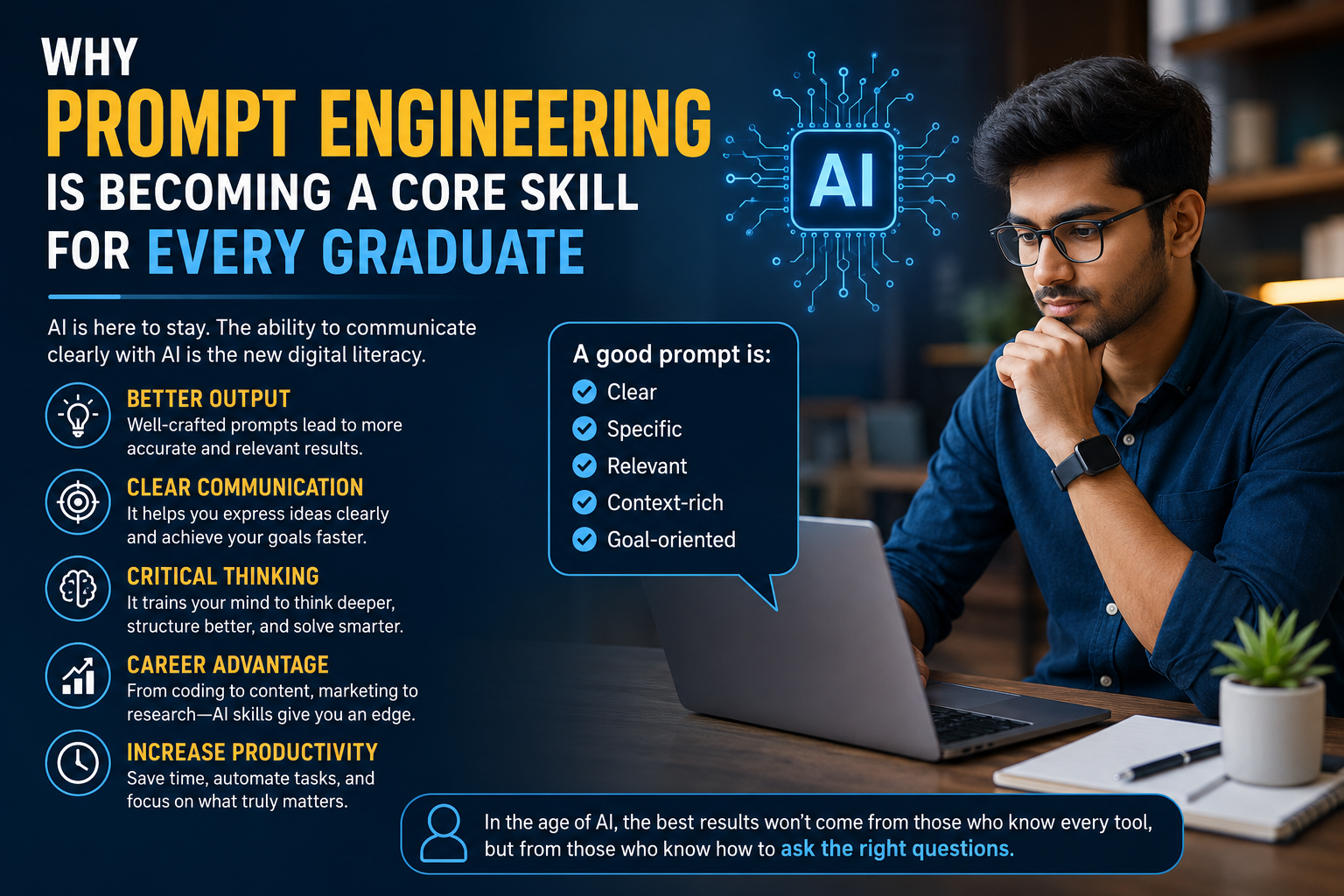
    Why Prompt Engineering is Becoming a Core Skill for Every Graduate

    Why Prompt Engineering is Becoming a Core Skill for Every Graduate

    Artificial Intelligence is changing the way we learn, work, create, and solve problems. Just a few years ago, being proficient in Microsoft Office, programming, or internet research was considered a valuable skill. Today, another skill is rapidly joining that list—Prompt Engineering.

    Despite the technical name, prompt engineering is not just for AI researchers or software developers. It is a practical skill that every graduate, regardless of their discipline, should develop.

    What is Prompt Engineering?

    A prompt is simply an instruction or question you give to an AI system. Prompt engineering is the ability to communicate with AI in a structured, clear, and purposeful way to obtain accurate, relevant, and useful results.

    Think of AI as an extremely knowledgeable assistant. If you ask vague questions, you will receive vague answers. If you provide clear context, objectives, and expectations, AI can produce remarkably valuable outputs.

    The difference is not only in the intelligence of the AI—it is in the quality of the instructions we provide.

    The Real Skill is Not Asking Questions—It’s Asking Better Questions

    Many people believe AI is becoming smarter every day. While that is true, another important reality often goes unnoticed.

    The people who benefit the most from AI are not necessarily those with the most advanced technology. They are the ones who know how to communicate with AI effectively.

    This requires:

    • Critical thinking
    • Logical reasoning
    • Clear communication
    • Domain knowledge
    • Creativity
    • Problem-solving ability

    Prompt engineering is therefore not a shortcut to success. It is an extension of human intelligence.

    Why Every Graduate Should Learn Prompt Engineering

    Whether you study Computer Science, Commerce, Management, Arts, Science, Law, or Medicine, AI is becoming part of your professional environment.

    A graduate who understands how to work with AI can:

    • Generate better ideas during brainstorming.
    • Analyze large amounts of information quickly.
    • Draft reports, presentations, and professional emails.
    • Learn new technologies faster.
    • Solve programming problems efficiently.
    • Conduct literature reviews.
    • Improve productivity without compromising quality.

    In today’s workplace, the ability to collaborate with AI is becoming as important as the ability to use computers two decades ago.

    Prompt Engineering is Not About Replacing Thinking

    One of the biggest misconceptions is that AI eliminates the need to think.

    In reality, AI rewards thoughtful users.

    If you lack subject knowledge, AI may produce convincing but incorrect answers. If you cannot evaluate its output, you risk making poor decisions.

    Prompt engineering therefore strengthens—not replaces—human intelligence.

    The best professionals will use AI to enhance their expertise, not substitute it.

    The Evolution of Digital Skills

    Technology education has always evolved.

    We moved from:

    • Learning basic computer operations
    • Using Microsoft Office
    • Browsing the internet effectively
    • Learning programming languages
    • Building websites and mobile applications
    • Understanding cloud computing
    • Working with data analytics

    Today, AI collaboration is the next step in this journey.

    Prompt engineering is becoming another essential digital literacy skill.

    Prompt Engineering Across Different Careers

    Software Developers

    Generate code, debug applications, explain algorithms, write documentation, and optimize software solutions.

    Teachers

    Prepare lesson plans, create assessments, generate examples, simplify complex concepts, and personalize learning experiences.

    Researchers

    Summarize research papers, identify trends, organize literature reviews, and generate research ideas.

    Business Professionals

    Create reports, analyze market trends, draft proposals, and improve decision-making.

    Content Creators

    Develop content ideas, improve writing, generate scripts, and enhance creativity.

    Every profession is finding new ways to integrate AI into daily work.

    The Future Belongs to AI Collaborators

    The future is not a competition between humans and AI.

    It is a collaboration.

    Those who understand how to ask better questions, validate responses, and apply human judgment will always have an advantage.

    AI cannot replace curiosity.
    It cannot replace ethics.
    It cannot replace creativity.

    It cannot replace empathy.
    It cannot replace wisdom.

    These remain uniquely human strengths.

    A Message for Students

    Do not use AI simply to complete assignments.

    Use it to understand concepts.
    Challenge your assumptions.
    Explore multiple perspectives.
    Practice solving real-world problems.

    The goal is not to become dependent on AI.

    The goal is to become more capable because of AI.

    Final Thoughts

    Prompt engineering is far more than learning a few tricks to interact with ChatGPT or other AI tools. It represents a new way of thinking—one that combines communication, reasoning, creativity, and technical understanding.

    Just as computer literacy became essential in the digital era, AI literacy and prompt engineering are becoming essential in the age of intelligent systems.

    The graduates who will succeed tomorrow are not those who fear AI or blindly depend on it. They are those who understand its strengths, recognize its limitations, and know how to use it responsibly to solve meaningful problems.

    In the AI era, asking better questions may become one of the most valuable professional skills anyone can possess.