
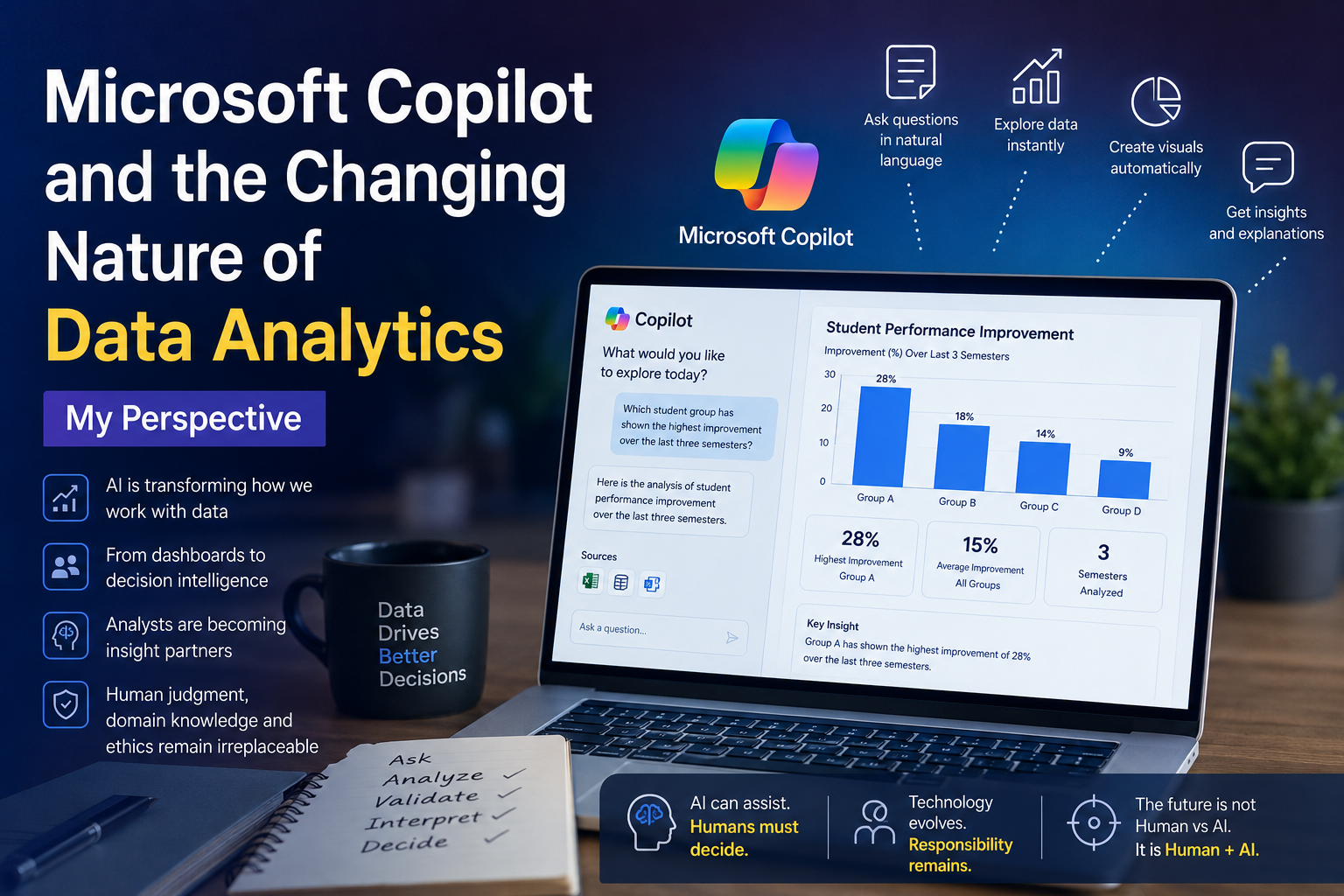
Microsoft Copilot and the Changing Nature of Data Analytics: My Perspective
Data analytics is undergoing a significant transformation.
For many years, the work of a data analyst involved collecting data, cleaning datasets, writing queries, creating calculations, developing dashboards, identifying patterns, and finally communicating insights to decision-makers.
Today, Artificial Intelligence is changing almost every stage of this process.
One technology that I find particularly interesting in this transformation is Microsoft Copilot.
From my perspective as an educator and researcher working with Data Science, AI, Machine Learning and analytics, Copilot is not simply another productivity tool. It represents a shift in the way people interact with data.
From “How do I analyse this?” to “What do I want to know?”
Traditionally, analysts needed to understand technical processes before reaching meaningful insights.
For example, a user might need to know:
How to write a SQL query
How to create a DAX measure
How to transform data
How to select an appropriate visualization
How to interpret statistical results
AI-assisted analytics is changing this interaction.
A user can increasingly begin with a natural-language question such as:
“Which student group has shown the highest improvement over the last three semesters?”
or
“Which product category contributed most to the decline in sales?”
The system can assist in identifying relevant data, generating calculations, suggesting visualizations and explaining patterns.
This makes analytics more accessible to people who may not have advanced programming or statistical skills.
But does this mean analysts are becoming less important?
I don’t think so.
I believe the role of the analyst is changing rather than disappearing.
The most important skill of the future analyst may not be simply knowing how to create a chart or write a formula.
It will be the ability to ask the right questions.
An AI system can help generate a visualization, but the analyst must determine:
Is this the right visualization?
AI can identify a correlation, but the analyst must ask:
Does this correlation actually make sense in the real-world context?
AI can generate an insight, but the analyst must determine:
Can this insight be trusted and used for decision-making?
This is where domain knowledge, critical thinking and analytical reasoning remain extremely important.
From Dashboard Developer to Insight Partner
I see an important shift happening here.
The traditional analyst was often expected to produce reports and dashboards.
The emerging analyst is increasingly expected to become an insight partner.
Instead of simply answering:
“What happened?”
the analyst should help organizations understand:
“Why did it happen?”
“What could happen next?”
“What should we do about it?”
This takes analytics from reporting toward decision intelligence.
Tools such as Microsoft Copilot can accelerate this transition by reducing the amount of time spent on repetitive technical tasks.
Copilot can increase productivity—but it cannot replace responsibility
One of the biggest advantages of AI-assisted analytics is productivity.
Tasks that previously required considerable time can potentially be accelerated:
Data → Query → Calculation → Visualization → Explanation → Insight
However, there is an important caution.
AI-generated results should not automatically be considered correct.
A generated formula may be technically valid but conceptually wrong.
A visualization may look impressive but communicate a misleading message.
An AI-generated explanation may sound convincing while overlooking an important variable.
Therefore, human validation remains essential.
This is particularly important when analytics is used in areas such as education, finance, healthcare, employment or public policy.
The importance of Data Literacy
Another major change I see is the growing importance of data literacy.
Previously, organizations often divided people into two groups:
Technical people – who worked with data.
Non-technical people – who consumed reports.
AI-assisted analytics is gradually reducing this gap.
Business users, teachers, researchers, managers and students can increasingly interact with data using natural language.
But accessibility does not automatically create understanding.
A person still needs to understand concepts such as:
Data quality
Bias
Correlation vs causation
Sampling
Statistical significance
Data privacy
Model limitations
Visualization principles
Therefore, I believe that AI literacy and data literacy must develop together.
What does this mean for students?
As an educator, this is perhaps the area I find most interesting.
Students learning Data Science today should not focus only on memorizing syntax.
Learning Python, SQL, Power BI, statistics and Machine Learning remains important.
But students should also learn how to:
Ask better questions.
Evaluate AI-generated answers.
Interpret data critically.
Validate analytical results.
Communicate insights clearly.
Understand ethical implications.
The future data professional will need a combination of technical skills + analytical thinking + domain knowledge + AI literacy.
My Perspective
I don’t see Microsoft Copilot as a replacement for the data analyst.
I see it as a co-pilot for the analyst.
The word “Copilot” itself gives an interesting perspective.
A copilot assists with navigation, but the pilot remains responsible for the journey.
Similarly, AI can assist us with data exploration, calculations, visualizations and explanations.
But humans must remain responsible for the questions we ask, the decisions we make and the consequences of those decisions.
The real competitive advantage will therefore not come from simply knowing how to use Copilot.
It will come from knowing when to use it, how to question it, how to validate it, and how to turn its output into meaningful decisions.
The Future of Data Analytics
I believe the future of analytics will not be:
Human vs AI
It will increasingly be:
Human + AI
The analysts who embrace AI while strengthening their statistical thinking, domain expertise, communication skills and ethical judgment will be better positioned for the future.
For me, the most exciting question is no longer:
“Can AI analyse data?”
It is:
“What better decisions can humans make when AI helps them understand data more effectively?”
That is where I believe the next chapter of data analytics is beginning.