
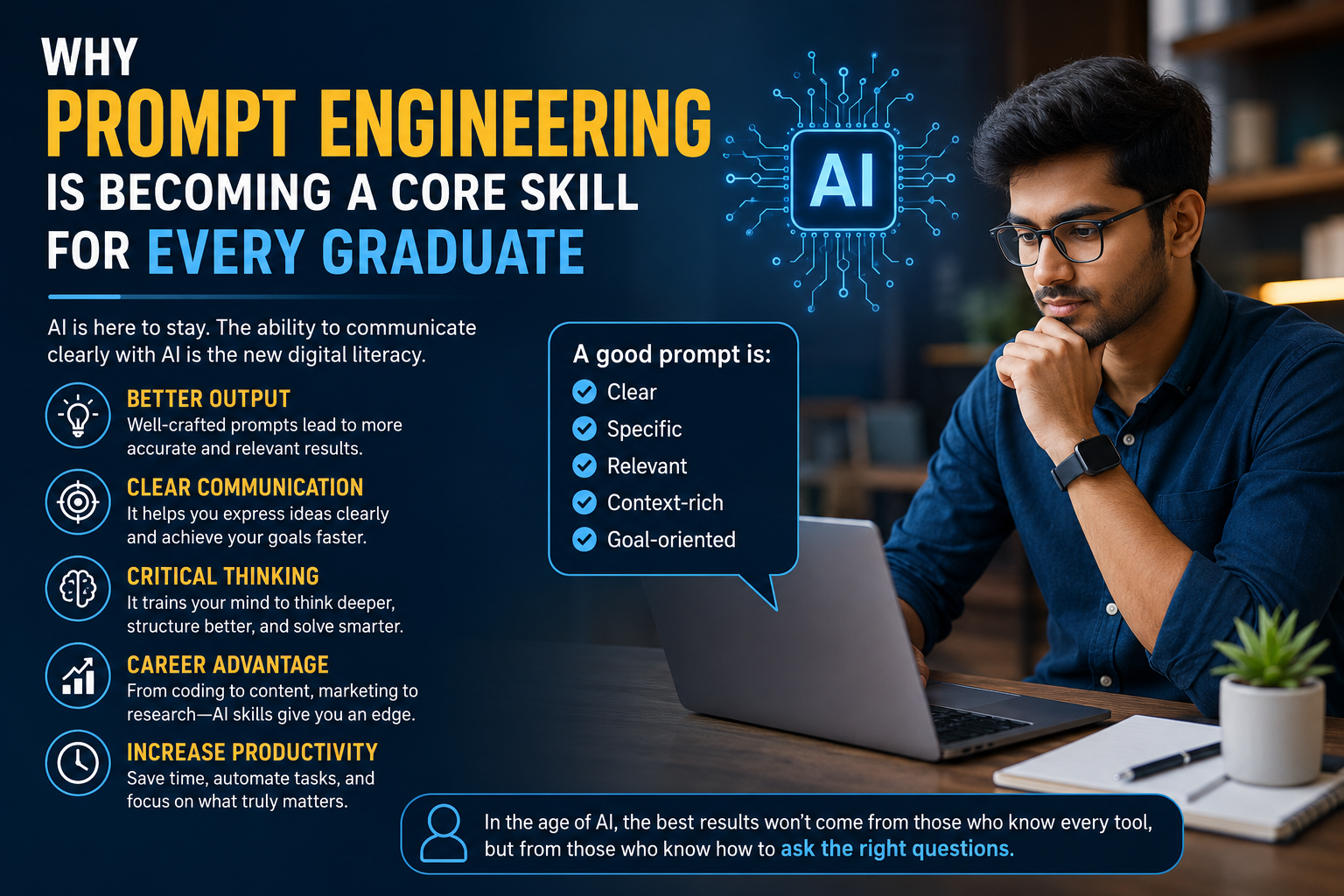
Why Prompt Engineering is Becoming a Core Skill for Every Graduate
Artificial Intelligence is changing the way we learn, work, create, and solve problems. Just a few years ago, being proficient in Microsoft Office, programming, or internet research was considered a valuable skill. Today, another skill is rapidly joining that list—Prompt Engineering.
Despite the technical name, prompt engineering is not just for AI researchers or software developers. It is a practical skill that every graduate, regardless of their discipline, should develop.
What is Prompt Engineering?
A prompt is simply an instruction or question you give to an AI system. Prompt engineering is the ability to communicate with AI in a structured, clear, and purposeful way to obtain accurate, relevant, and useful results.
Think of AI as an extremely knowledgeable assistant. If you ask vague questions, you will receive vague answers. If you provide clear context, objectives, and expectations, AI can produce remarkably valuable outputs.
The difference is not only in the intelligence of the AI—it is in the quality of the instructions we provide.
The Real Skill is Not Asking Questions—It’s Asking Better Questions
Many people believe AI is becoming smarter every day. While that is true, another important reality often goes unnoticed.
The people who benefit the most from AI are not necessarily those with the most advanced technology. They are the ones who know how to communicate with AI effectively.
This requires:
- Critical thinking
- Logical reasoning
- Clear communication
- Domain knowledge
- Creativity
- Problem-solving ability
Prompt engineering is therefore not a shortcut to success. It is an extension of human intelligence.
Why Every Graduate Should Learn Prompt Engineering
Whether you study Computer Science, Commerce, Management, Arts, Science, Law, or Medicine, AI is becoming part of your professional environment.
A graduate who understands how to work with AI can:
- Generate better ideas during brainstorming.
- Analyze large amounts of information quickly.
- Draft reports, presentations, and professional emails.
- Learn new technologies faster.
- Solve programming problems efficiently.
- Conduct literature reviews.
- Improve productivity without compromising quality.
In today’s workplace, the ability to collaborate with AI is becoming as important as the ability to use computers two decades ago.
Prompt Engineering is Not About Replacing Thinking
One of the biggest misconceptions is that AI eliminates the need to think.
In reality, AI rewards thoughtful users.
If you lack subject knowledge, AI may produce convincing but incorrect answers. If you cannot evaluate its output, you risk making poor decisions.
Prompt engineering therefore strengthens—not replaces—human intelligence.
The best professionals will use AI to enhance their expertise, not substitute it.
The Evolution of Digital Skills
Technology education has always evolved.
We moved from:
- Learning basic computer operations
- Using Microsoft Office
- Browsing the internet effectively
- Learning programming languages
- Building websites and mobile applications
- Understanding cloud computing
- Working with data analytics
Today, AI collaboration is the next step in this journey.
Prompt engineering is becoming another essential digital literacy skill.
Prompt Engineering Across Different Careers
Software Developers
Generate code, debug applications, explain algorithms, write documentation, and optimize software solutions.
Teachers
Prepare lesson plans, create assessments, generate examples, simplify complex concepts, and personalize learning experiences.
Researchers
Summarize research papers, identify trends, organize literature reviews, and generate research ideas.
Business Professionals
Create reports, analyze market trends, draft proposals, and improve decision-making.
Content Creators
Develop content ideas, improve writing, generate scripts, and enhance creativity.
Every profession is finding new ways to integrate AI into daily work.
The Future Belongs to AI Collaborators
The future is not a competition between humans and AI.
It is a collaboration.
Those who understand how to ask better questions, validate responses, and apply human judgment will always have an advantage.
AI cannot replace curiosity.
It cannot replace ethics.
It cannot replace creativity.
It cannot replace empathy.
It cannot replace wisdom.
These remain uniquely human strengths.
A Message for Students
Do not use AI simply to complete assignments.
Use it to understand concepts.
Challenge your assumptions.
Explore multiple perspectives.
Practice solving real-world problems.
The goal is not to become dependent on AI.
The goal is to become more capable because of AI.
Final Thoughts
Prompt engineering is far more than learning a few tricks to interact with ChatGPT or other AI tools. It represents a new way of thinking—one that combines communication, reasoning, creativity, and technical understanding.
Just as computer literacy became essential in the digital era, AI literacy and prompt engineering are becoming essential in the age of intelligent systems.
The graduates who will succeed tomorrow are not those who fear AI or blindly depend on it. They are those who understand its strengths, recognize its limitations, and know how to use it responsibly to solve meaningful problems.
In the AI era, asking better questions may become one of the most valuable professional skills anyone can possess.