
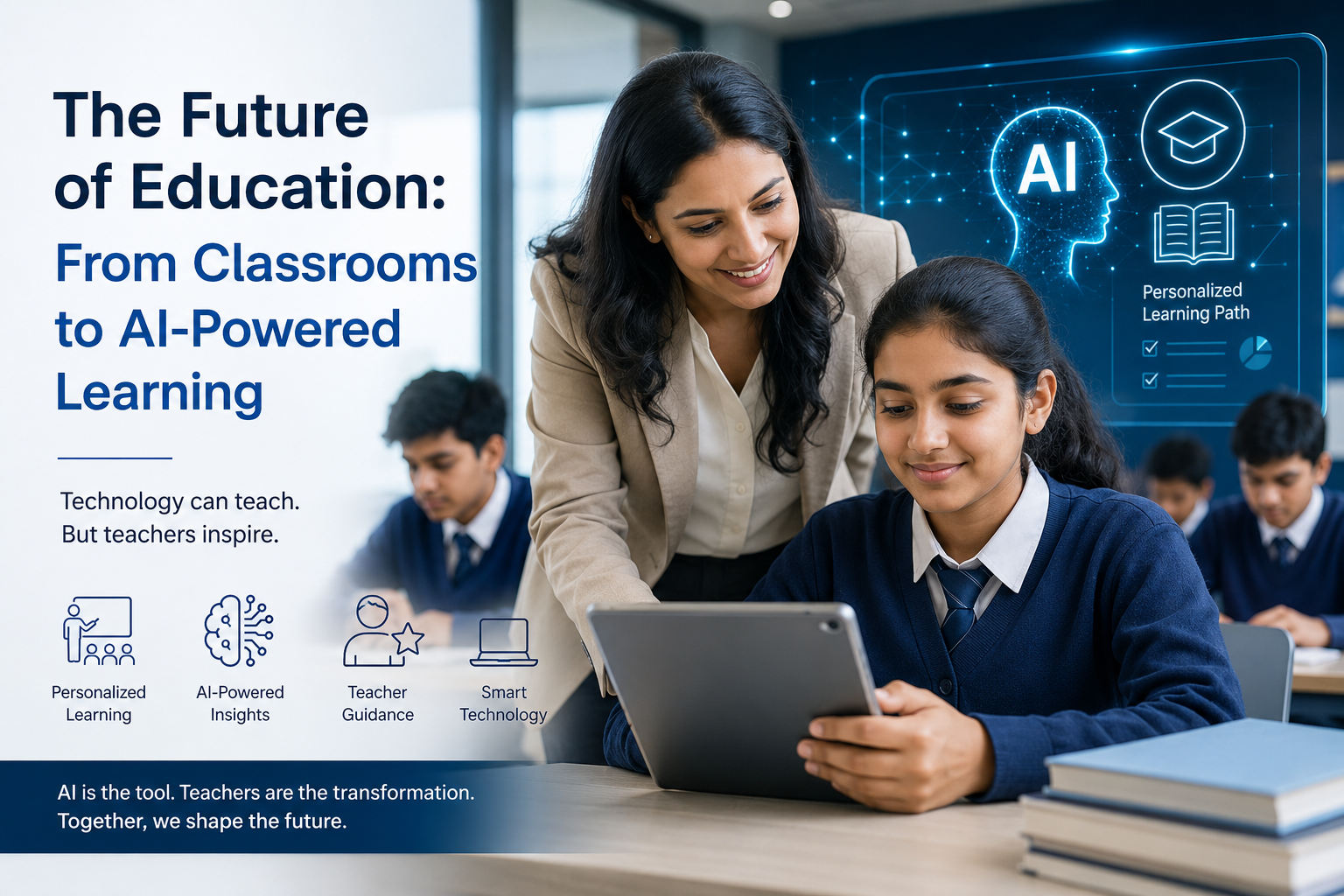
The Future of Education: From Classrooms to AI-Powered Learning
Education has always evolved with society.
From blackboards to smartboards, from textbooks to online learning platforms, every generation of students has experienced a different way of learning. Today, we are standing at another important turning point — Artificial Intelligence is becoming part of education.
But the real question is not “Will AI change education?”
It already is.
The bigger question is:
How do we make sure technology improves learning without taking away the human side of education?
From One Classroom to Individual Learning
Traditionally, a teacher enters a classroom with one lesson plan for an entire group of students.
But every student is different.
One student may understand a concept immediately, while another may need three more examples. Some students learn better through videos, others through practice, discussion or real-world examples.
AI has the potential to support this difference.
It can help students practise at their own pace, identify areas where they are struggling and receive explanations in different ways.
This doesn’t mean replacing the teacher.
It means giving the teacher better tools to understand and support learners.
The Teacher’s Role Is Changing
There is often a fear that AI will replace teachers.
I believe the opposite can happen.
As AI takes care of some repetitive tasks — generating practice questions, analysing learning patterns, preparing basic content or providing instant feedback — teachers can spend more time on what technology cannot easily replace:
mentoring, motivating, questioning, listening and understanding students.
A teacher is not simply someone who delivers information.
A good teacher helps a student believe:
“I can do this.”
That human connection will remain extremely important, even in an AI-powered classroom.
Students Need More Than AI Tools
There is another challenge.
If students use AI only to get quick answers, education could actually become weaker.
The goal should not be to create students who know how to ask AI for answers.
The goal should be to create students who know how to:
Ask meaningful questions
Think critically
Verify information
Solve problems
Work creatively
Communicate effectively
Use AI responsibly
In other words, AI literacy must become part of modern education.
The Classroom Will Not Disappear
I don’t think the future of education is a choice between a teacher and a computer.
It is more likely to be a combination of both.
Imagine a classroom where AI helps a teacher understand individual learning gaps, while the teacher uses that information to guide students personally.
Imagine students working on real-world projects, using AI as an assistant while learning to question its answers.
Imagine assessments focusing less on memorising information and more on problem-solving, creativity and application.
That is the kind of transformation worth pursuing.
Technology Should Serve Education — Not Define It
We should not introduce AI into education simply because it is the latest technology.
The important question should always be:
Does this technology help students learn better?
If the answer is yes, we should embrace it.
If it creates dependency, reduces critical thinking or removes meaningful human interaction, we need to rethink how we use it.
The future classroom may look very different from the classroom we grew up in.
But one thing should remain unchanged:
At the heart of education is a human being trying to learn, and another human being helping them grow.
AI can make education smarter.
But teachers make education meaningful.
And perhaps the future of education is not classroom versus AI.
It is classroom + teacher + student + AI — working together.