
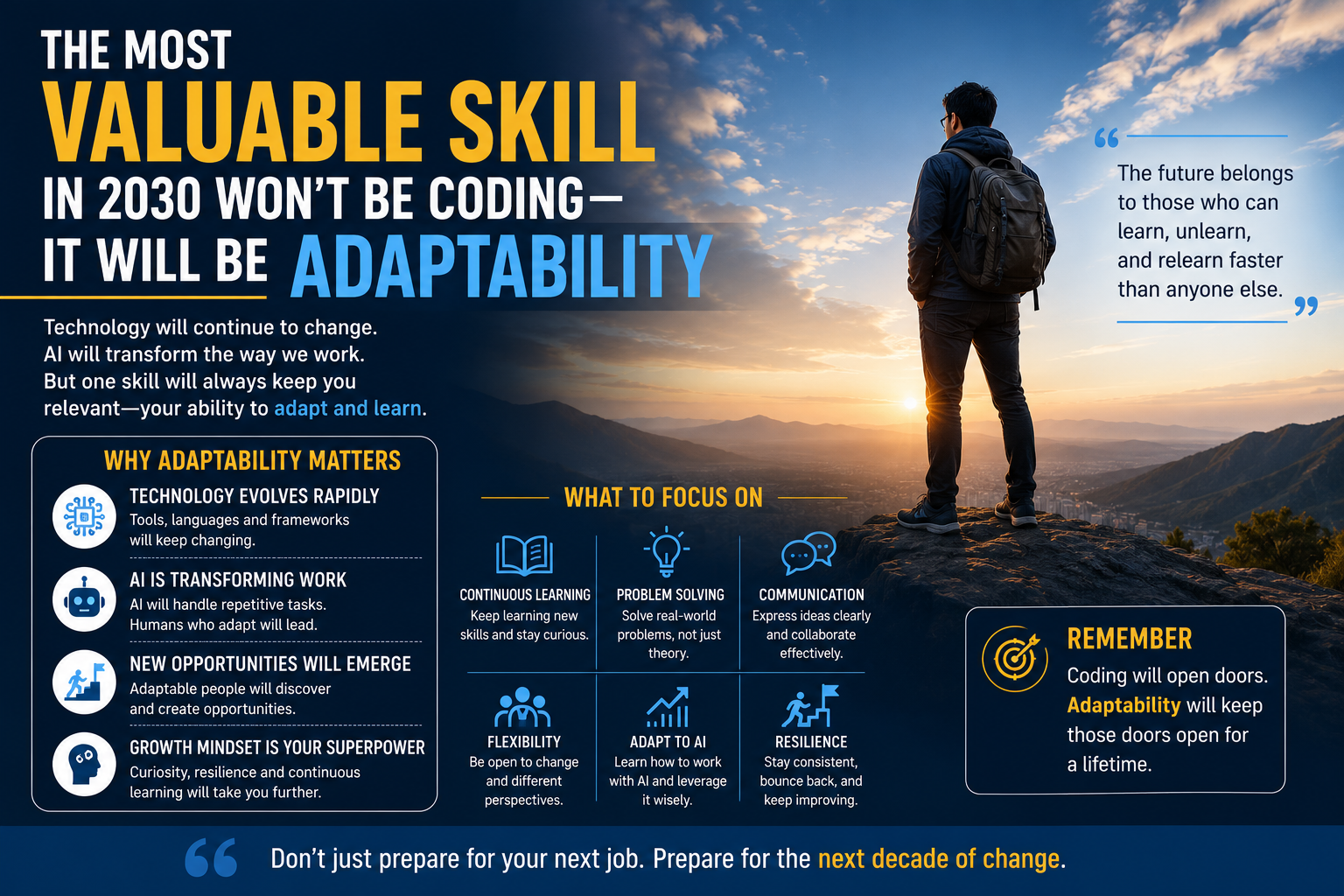
The Most Valuable Skill in 2030 Won’t Be Coding—It Will Be Adaptability
For years, students have asked me a familiar question:
“Sir, which programming language should I learn to secure a good career?”
A decade ago, my answer might have been Java.
A few years later, it could have been Python.
Today, many expect me to say Artificial Intelligence or Prompt Engineering.
But my answer has changed.
The most valuable skill in 2030 won’t be coding. It will be adaptability.
Before anyone misunderstands me, let me be clear—I am not saying coding is becoming unimportant. As a Computer Science educator, I know programming will continue to be one of the foundations of technology.
What I am saying is this:
Programming languages will change. Frameworks will evolve. AI tools will become smarter. But the ability to learn, adapt, and grow will remain the most valuable skill of all.
Technology Has Never Stood Still
When I began my journey in technology, software development looked very different from what it does today.
We moved from desktop applications to web applications.
From static HTML pages to dynamic web frameworks.
From procedural programming to object-oriented design.
From traditional mobile development to Flutter and Jetpack Compose.
From local servers to cloud computing.
Today, we are working alongside Artificial Intelligence.
Every few years, the technologies change.
What remains constant is the need to keep learning.
Looking back, I realise that the professionals who succeeded weren’t always the ones who knew the latest programming language.
They were the ones who embraced change instead of fearing it.
Knowledge Has an Expiry Date
This is perhaps one of the biggest lessons every student should understand.
Technical knowledge has a shelf life.
The language you master today may become less relevant tomorrow.
The framework that dominates the industry today may be replaced within a few years.
Even AI tools that seem revolutionary today will evolve rapidly.
If your identity is built around a single technology, your career becomes vulnerable.
If your identity is built around learning, your opportunities become limitless.
Coding Teaches Logic. Adaptability Builds Careers.
Learning programming develops analytical thinking, logical reasoning, and problem-solving abilities.
Those skills will always matter.
However, the workplace of 2030 will demand something more.
Employers will value professionals who can:
- Learn new technologies quickly.
- Work effectively with AI tools.
- Solve unfamiliar problems.
- Collaborate across different domains.
- Think critically instead of relying blindly on technology.
- Communicate ideas clearly.
- Continue learning throughout their careers.
In other words, they will value people who are adaptable.
AI Is Changing the Nature of Work
Artificial Intelligence can now generate code, write reports, analyse data, design presentations, and even explain complex concepts.
Naturally, many students worry.
“Will there still be opportunities for us?”
I believe the answer is yes—but the opportunities will look different.
AI is automating repetitive tasks.
That means human value shifts toward creativity, judgment, decision-making, ethics, leadership, and continuous learning.
Instead of competing with AI, professionals will increasingly work alongside it.
The question will no longer be:
“Can you write code?”
It will become:
“Can you solve problems, learn quickly, and use technology responsibly?”
The Career of the Future Belongs to Continuous Learners
One observation has remained consistent throughout my teaching career.
The students who perform best in the long run are rarely those who memorise the most.
They are the students who stay curious.
They ask questions.
They experiment.
They make mistakes.
They improve.
They never stop learning.
Those habits matter far more than mastering a single programming language.
Education Must Also Adapt
If industries are evolving, education cannot remain unchanged.
As educators, our responsibility is no longer limited to completing a syllabus.
We must prepare students for careers that may not even exist today.
That means encouraging:
- Project-based learning.
- Practical problem-solving.
- AI literacy.
- Communication skills.
- Teamwork.
- Innovation.
- Entrepreneurial thinking.
- Lifelong learning.
Education should not simply prepare students for their first job.
It should prepare them for the next twenty years of change.
My Message to Students
Don’t chase every new technology simply because it is trending.
Instead, build strong fundamentals.
Learn programming.
Understand databases.
Develop logical thinking.
Strengthen communication.
Learn how AI works.
Most importantly, develop the confidence to learn something completely new whenever the situation demands it.
That confidence is adaptability.
Final Thoughts
The future doesn’t belong to the person who knows one programming language perfectly.
It belongs to the person who can learn the next one with confidence.
Technology will continue to evolve.
Artificial Intelligence will continue to transform industries.
New careers will emerge, while others will disappear.
But one quality will continue to separate successful professionals from everyone else:
The willingness to adapt.
As I often tell my students, your degree may help you get your first opportunity, your technical skills may help you perform well, but your adaptability will determine how far you go in your career.
In the end, careers are not built by resisting change.
They are built by learning, evolving, and embracing it.
Because in 2030, the greatest competitive advantage won’t simply be what you know—it will be how quickly you can learn what comes next.