
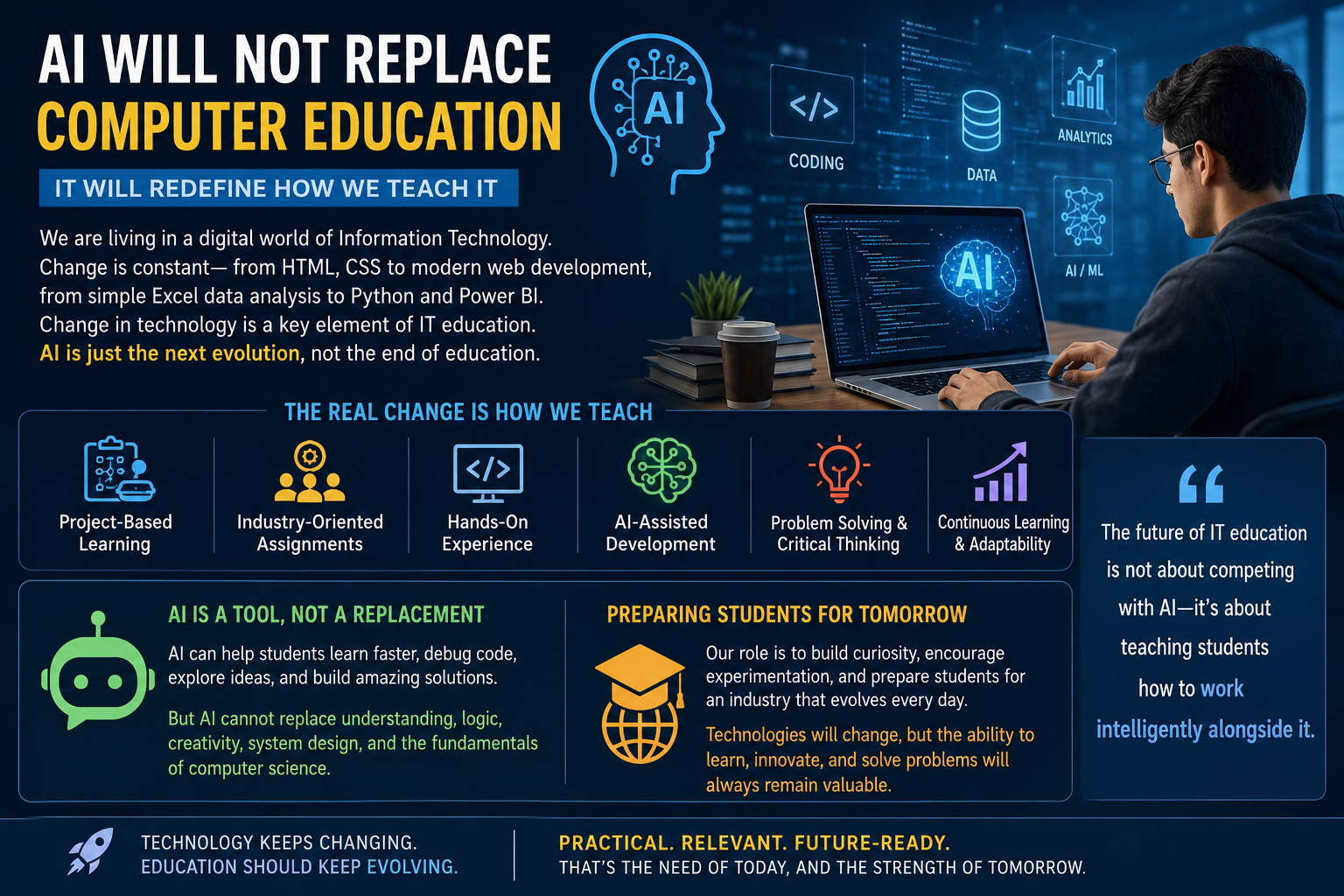
Artificial Intelligence has sparked an important discussion across the education sector. Many believe AI will completely transform—or even replace—computer education. My perspective is different.
AI will not replace computer education. It will simply become the next chapter in its evolution.
The field of Information Technology has always been driven by continuous change. Every generation of technology professionals has adapted to new tools, programming languages, frameworks, and methodologies.
Think about the journey:
- We moved from static HTML websites to dynamic, full-stack web development.
- We evolved from basic CSS to responsive design frameworks and modern UI technologies.
- Data analysis progressed from spreadsheets like Microsoft Excel to Python, Power BI, and AI-powered analytics.
- Software development shifted from traditional desktop applications to cloud computing, mobile applications, DevOps, and now AI-assisted development.
None of these advancements eliminated computer education. Instead, they expanded what students needed to learn.
Today, AI is simply the next technological milestone.
The Real Change Is Not What We Teach—It’s How We Teach
The greatest transformation should happen inside our classrooms.
For years, computer education has often emphasized theory, definitions, and examinations. While theoretical knowledge remains important, today’s technology industry expects graduates who can solve real-world problems, build applications, analyze data, collaborate effectively, and continuously learn new technologies.
As educators, we need to shift our focus toward:
- Project-based learning
- Industry-oriented assignments
- Hands-on programming experience
- AI-assisted software development
- Problem-solving and critical thinking
- Continuous learning and adaptability
Students should graduate not only with knowledge but with the confidence to apply that knowledge in professional environments.
AI Is a Tool, Not a Replacement
Just as calculators did not replace mathematics, AI will not replace computer science education.
Instead, AI can help students:
- Learn concepts faster
- Debug code more efficiently
- Explore multiple programming approaches
- Build innovative applications
- Improve productivity
However, AI cannot replace the understanding of algorithms, logical thinking, system design, software engineering principles, or creativity. These remain the foundation of every successful technology professional.
Preparing Students for Tomorrow
The role of educators is no longer limited to delivering content. Our responsibility is to prepare students for an industry that evolves every day.
This means encouraging curiosity, experimentation, lifelong learning, and adaptability. Technologies will continue to change, but the ability to learn, innovate, and solve problems will always remain valuable.
Final Thoughts
Technology has never stood still, and neither should education.
AI is not the end of computer education—it is another milestone in its journey. The future belongs to educators who embrace innovation and to students who are willing to learn beyond textbooks.
If we adapt our teaching methods to become more practical, industry-focused, and innovation-driven, AI will strengthen computer education rather than diminish it.
The future of IT education is not about competing with AI—it’s about teaching students how to work intelligently alongside it.
What are your thoughts? Do you believe AI will replace computer education, or will it simply reshape how we teach and learn? I’d love to hear your perspective.