
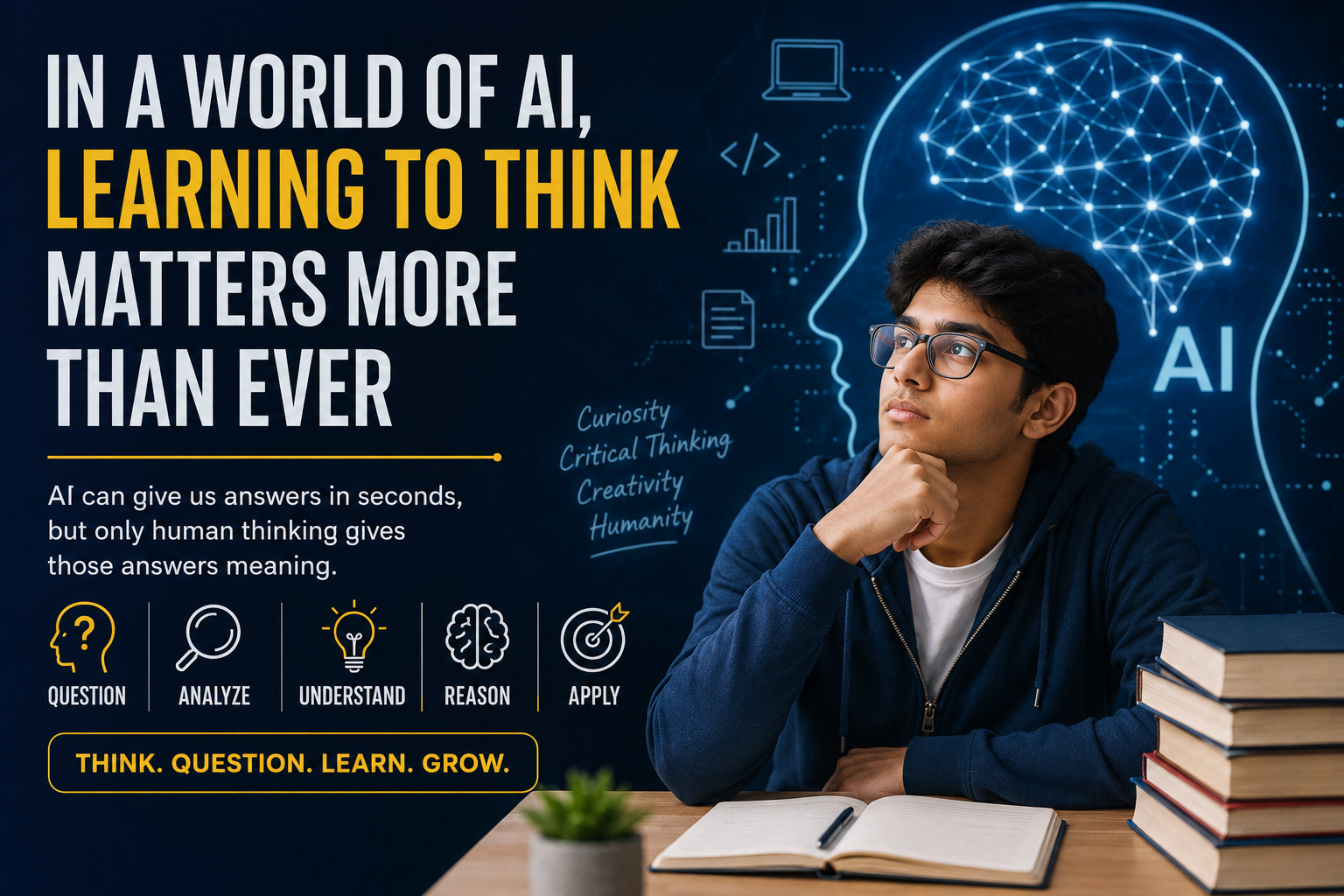
In a World of AI, Learning to Think Matters More Than Ever
We are living in a time when technology can give us an answer before we have even finished asking the question.
Artificial Intelligence can write an email, generate an image, explain a difficult concept, analyse data, write code, create presentations and even help us make decisions.
For students, this can feel exciting.
For teachers, it can also make us pause and think.
Because if AI can do so much for us, what should we teach the next generation?
I believe the answer is not to teach less.
It is to teach students how to think better.
The easy answer is not always the right answer
A student can now ask AI to solve a programming problem in seconds.
They can generate an assignment in minutes.
They can ask for a summary of a chapter without reading the chapter.
They can even ask AI to explain something they don’t understand.
There is nothing inherently wrong with using these tools.
In fact, learning to use technology responsibly is becoming an important skill.
But there is a difference between using AI as a learning companion and using AI as a replacement for thinking.
That difference matters.
If a student receives an answer but does not understand why it is correct, learning has not really happened.
If a student submits a beautifully written assignment but cannot explain it in their own words, the technology has completed the task—but the student has missed the learning.
Information is no longer the biggest challenge
For generations, education focused heavily on acquiring information.
We needed to remember facts, formulas, definitions and procedures.
Today, information is everywhere.
A student with a smartphone can access more information in a few seconds than previous generations could access in hours.
AI has taken this even further.
The challenge is no longer simply:
“Can you find the answer?”
The more important questions are:
“Is this answer correct?”
“Why do I believe it?”
“What evidence supports it?”
“What could be missing?”
“Can I apply it to a real situation?”
These questions require something technology cannot simply hand over to us:
judgement.
AI can generate. Humans must understand.
This is where education has an important responsibility.
We should not teach students to fear AI.
We should teach them to work with it.
But at the same time, students should understand that AI-generated content is not automatically knowledge.
A generated answer needs to be questioned.
A generated piece of code needs to be tested.
A generated research idea needs to be investigated.
A generated conclusion needs evidence.
And sometimes, the most valuable response is not accepting the first answer—but asking a better question.
That is why curiosity, critical thinking and problem-solving are becoming more important, not less.
I have seen this change in the classroom
As an educator, I have seen technology change the way students learn.
The tools available to today’s students are incredibly powerful.
But one thing has remained constant.
The students who grow the most are not necessarily those who know every tool.
They are the ones who are willing to ask:
“Why?”
“What if?”
“Can I try another way?”
“What happens if this doesn’t work?”
Those questions often lead to deeper learning than simply finding the correct answer.
A student who struggles with a problem but keeps trying may learn more than a student who gets the answer immediately.
Because education is not only about reaching the destination.
It is also about developing the ability to navigate the journey.
The skill we cannot outsource
We can outsource many tasks.
We can automate repetitive work.
We can use AI to analyse large amounts of information.
We can use technology to save time.
But we should be careful about outsourcing our thinking.
Because once we stop questioning, exploring and reasoning for ourselves, we gradually become dependent on the tool.
The purpose of technology should be to make us more capable—not less curious.
A calculator did not make mathematics meaningless.
The internet did not make learning unnecessary.
And AI does not make human thinking irrelevant.
Instead, every major technological change has challenged education to redefine what is truly valuable.
Today, that value increasingly lies in understanding, judgement, creativity, empathy and the ability to learn continuously.
To the students reading this
You don’t have to compete with AI.
Learn to use it.
Experiment with it.
Question it.
Learn from it.
But don’t allow it to do all the thinking for you.
Write your own first idea before asking AI for suggestions.
Try solving a problem before asking for the solution.
Read the source before accepting the summary.
Understand the code before running it.
And whenever AI gives you an answer, ask yourself:
“Do I understand this?”
That simple question can change the way you learn.
To educators
Our role is changing too.
We cannot simply be providers of information when information is available everywhere.
We need to become facilitators of curiosity.
We need to create classrooms where students can question, experiment, fail, discuss and try again.
Perhaps the most valuable thing a teacher can give a student today is not another answer.
It is the confidence to find, question and understand the answer.
Technology will keep changing
The tools we use today may look completely different a few years from now.
New models will emerge.
New applications will appear.
New careers will be created.
Some existing tasks will disappear.
We cannot predict every change.
But we can prepare students for change itself.
Teach them how to learn.
Teach them how to unlearn.
Teach them how to question.
Teach them how to adapt.
Teach them how to remain human in an increasingly digital world.
Because technology will continue to become smarter.
That makes human thinking even more valuable.
The real question
Perhaps the question we should be asking is not:
“Will AI replace us?”
Maybe we should ask:
“What kind of humans do we want to become in a world where AI can do more and more?”
For me, the answer begins with curiosity.
With the courage to ask questions.
With the patience to understand.
With the humility to say, “I don’t know yet.”
And with the willingness to keep learning.
Because in a world where machines can increasingly generate answers,
the ability to think deeply may become one of our most important human skills.
And perhaps that is what education has always been about—not simply preparing students to answer questions, but preparing them to ask better ones.
Technology will give us more answers.
Let us make sure we never stop thinking about the questions.