
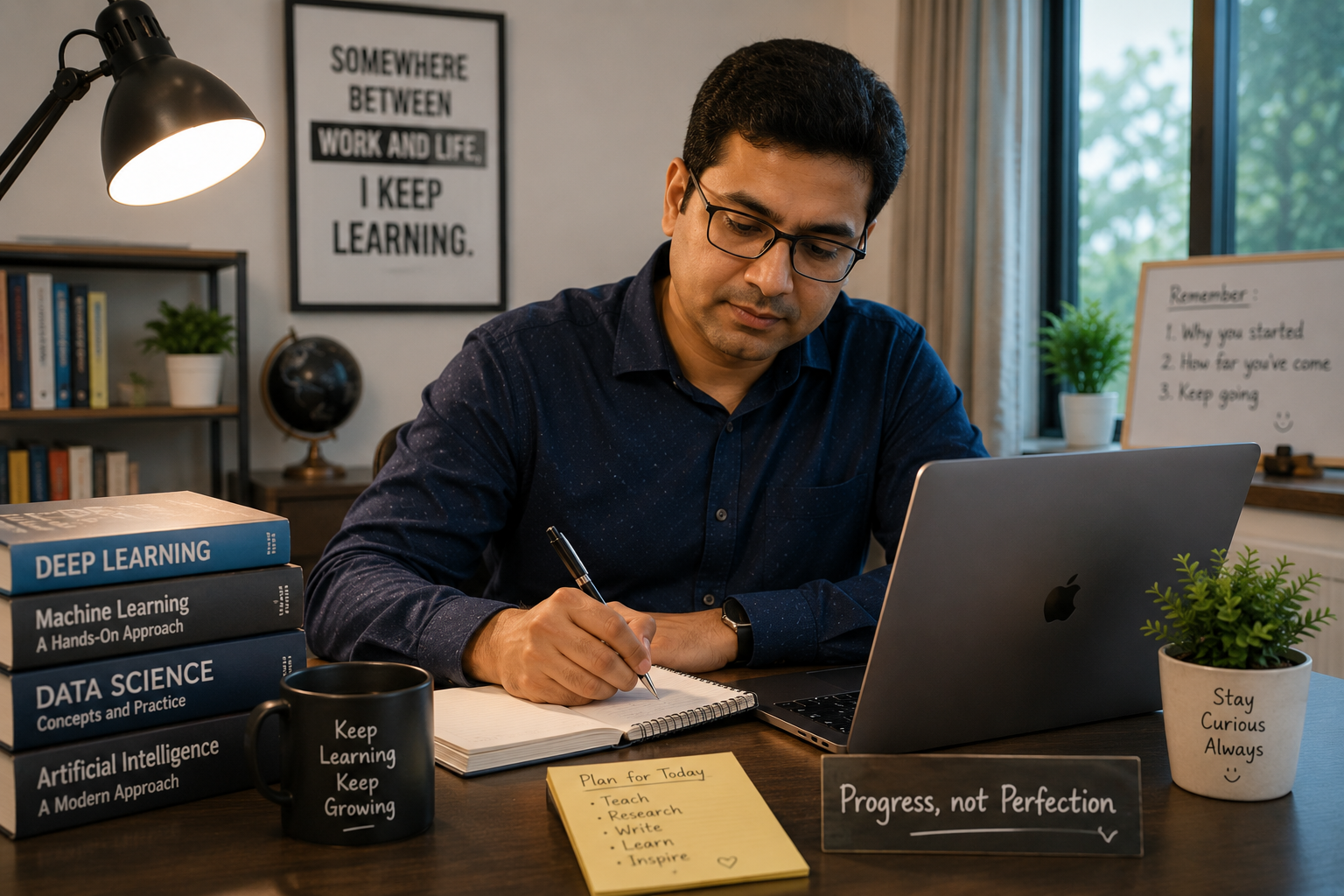
Somewhere Between Work and Life, I Keep Learning
Some days are planned.
Some days simply happen.
And then there are days when you start with one plan, end up doing ten different things, and still feel that something important remains unfinished.
That is probably what an ordinary day looks like for me.
Between teaching students, preparing for classes, answering messages, attending meetings, working on research, exploring technology, writing, and trying to give some time to life outside work, I have slowly realised something:
I am still learning. Every single day.
Not just from books, research papers, or technology.
I learn from students.
I learn from mistakes.
I learn from conversations.
And sometimes, I learn from the days that don’t go the way I expected.
The day usually starts with a list
Like many people, I often begin my day with a mental list.
There are classes to take.
Something needs to be prepared.
A student needs guidance.
An email needs a reply.
A meeting is waiting.
There is research work that I promised myself I would complete.
And somewhere in between all this, there is always that one small task that keeps getting postponed to “later.”
The interesting thing about “later” is that it rarely comes.
By the end of the day, another list has already taken its place.
Earlier, I used to feel that being productive meant completing everything on my list.
With time, I have started looking at it differently.
Sometimes productivity is simply doing the work that matters most and accepting that everything cannot be finished in one day.
That has been a lesson in itself.
Then comes the classroom
For me, the classroom has never been just a place where I teach a subject.
It is a place where I learn how differently people think.
I may enter a class with a lesson plan, examples, and an idea of how the session should go.
But students have a way of changing the plan.
One unexpected question can take the discussion in a completely different direction.
Sometimes a student asks something that makes me stop and think.
Sometimes the question is very basic.
Sometimes it is surprisingly advanced.
And sometimes I don’t have the answer immediately.
Earlier, I felt that a teacher was expected to know the answers.
Today, I believe something more important:
A teacher does not have to know everything. A teacher should be willing to keep learning.
When I tell students, “I don’t know. Let me check,” I don’t see it as a weakness.
I see it as an opportunity to show them that learning does not stop when you become a teacher.
Technology keeps reminding me that learning has no finish line
Technology has made this even more obvious.
The technology I teach today is not necessarily the technology I started with.
Languages change.
Frameworks change.
Tools change.
AI has changed the way we think about software, education, research and even learning itself.
Just when you become comfortable with one tool, another one appears.
There was a time when learning a programming language felt like a major achievement.
Today, knowing the language is only one part of the journey.
We also need to understand how to use tools intelligently, how to evaluate information, how to solve problems, and most importantly, how to think.
That is perhaps one of the biggest changes I have witnessed as a teacher.
Students can access information faster than ever.
But access to information is not the same as understanding.
And using AI is not the same as learning.
The real question is not, “Can AI do this for me?”
The better question is:
“What can I learn from using AI, and what still requires my own thinking?”
Research has taught me patience
Research is another part of my everyday life.
And research has taught me something that classrooms and technology could not teach me in quite the same way:
Patience.
There are days when an idea looks exciting.
Then comes the data.
Then the analysis.
Then the revisions.
Then another question.
Then another paper to read.
Sometimes something that seemed simple becomes complicated.
Sometimes the result is not what you expected.
And sometimes you spend hours working on something only to realise that you need to go back and start again.
It can be frustrating.
But perhaps that is the nature of research.
Research does not always reward speed.
It rewards curiosity, consistency and the willingness to keep going.
My PhD journey reinforced that lesson for me.
Completing a PhD was an important milestone, but the journey did not make me feel that I had “finished learning.”
If anything, it made me realise how much more there is to learn.
The part of the day nobody sees
There is also a part of professional life that people rarely see.
The preparation.
The corrections.
The follow-ups.
The unanswered messages.
The small administrative tasks.
The planning that happens before a class.
The thinking that continues even after leaving the classroom.
From the outside, a person’s work may look simple.
“Today he had classes.”
But a class is not just the hour spent in front of students.
There is preparation before it and reflection after it.
The same is true for research, projects, events and almost everything else we do.
A lot of work happens quietly.
There are no photographs for it.
No applause.
No LinkedIn post.
No certificate.
Just the satisfaction of knowing that something needed to be done, and you did it.
I have learned to value that kind of work more.
And then there is life
Of course, work is only one part of life.
There is family.
There are responsibilities.
There are conversations.
There are days when you are tired but still have something to take care of.
There are days when you want to sit quietly for a while, but the phone has other plans.
There are small moments too.
A cup of tea.
A conversation.
A laugh.
A message from a student.
A simple “Thank you, Sir.”
These moments may not look significant, but they often stay with us longer than the big achievements.
Over the years, I have started appreciating these small moments more.
Perhaps growing older does that to us.
We begin to understand that life is not made only of milestones.
It is made of ordinary days.
And sometimes, an ordinary day is actually a very good day.
Not every day is successful
I also don’t want to pretend that every day is productive.
Some days I accomplish a lot.
Some days I barely finish what was urgent.
Some days I feel motivated.
Some days I don’t.
There are moments when I question whether I am doing enough.
There are projects that take longer than expected.
There are ideas that never become reality.
There are plans that have to be changed.
Earlier, I used to think that these were signs of failure.
Now I think they are simply part of the journey.
We are often too hard on ourselves because we compare our everyday life with someone else’s highlight reel.
But real life is not a highlight reel.
It is messy.
It is unpredictable.
And sometimes, it is beautiful precisely because it is imperfect.
What students have taught me
After spending many years in teaching, I can say that students have taught me as much as I have taught them.
They have reminded me to be curious.
They have challenged my assumptions.
They have introduced me to new ways of using technology.
They have reminded me that the younger generation does not necessarily think the way we did.
And that is not a bad thing.
Education should not be about making students think exactly like us.
It should help them develop the confidence to think for themselves.
Sometimes, I may teach a student a concept today.
Years later, that student may teach me something I never expected.
That is one of the beautiful things about being a teacher.
The learning goes both ways.
Somewhere between work and life
When I look at my day now, I don’t see separate boxes labelled “teaching,” “research,” “technology,” “writing,” and “life.”
They overlap.
One experience influences another.
A classroom conversation may give me an idea for research.
Research may change how I teach.
Technology may change how I approach a problem.
A conversation outside work may give me a completely different perspective.
Perhaps that is why I like the phrase:
Somewhere between work and life, I keep learning.
Because that is exactly where I am.
Not at the end.
Not at the beginning.
Just somewhere in between.
Still learning.
Still experimenting.
Still making mistakes.
Still trying new things.
Still asking questions.
What I have realised
If there is one thing my journey has taught me, it is that learning does not have an age limit.
A degree does not end learning.
A designation does not end learning.
Experience does not end learning.
Even teaching does not end learning.
In fact, the more we learn, the more we realise how much we don’t know.
And maybe that is not something to be uncomfortable about.
Maybe that is something to celebrate.
Because as long as we remain curious, we remain open to growth.
So tomorrow, the routine will probably begin again.
Another class.
Another question.
Another meeting.
Another piece of research.
Another problem to solve.
Another idea.
Another unfinished task.
And perhaps, another lesson.
I don’t know exactly what tomorrow will teach me.
But I know I will show up.
I will try.
I will learn.
And somewhere between work and life, I will continue becoming a little better than I was yesterday.
Because perhaps the real achievement is not reaching a point where we know everything.
Perhaps it is reaching a point where we never stop wanting to learn.