
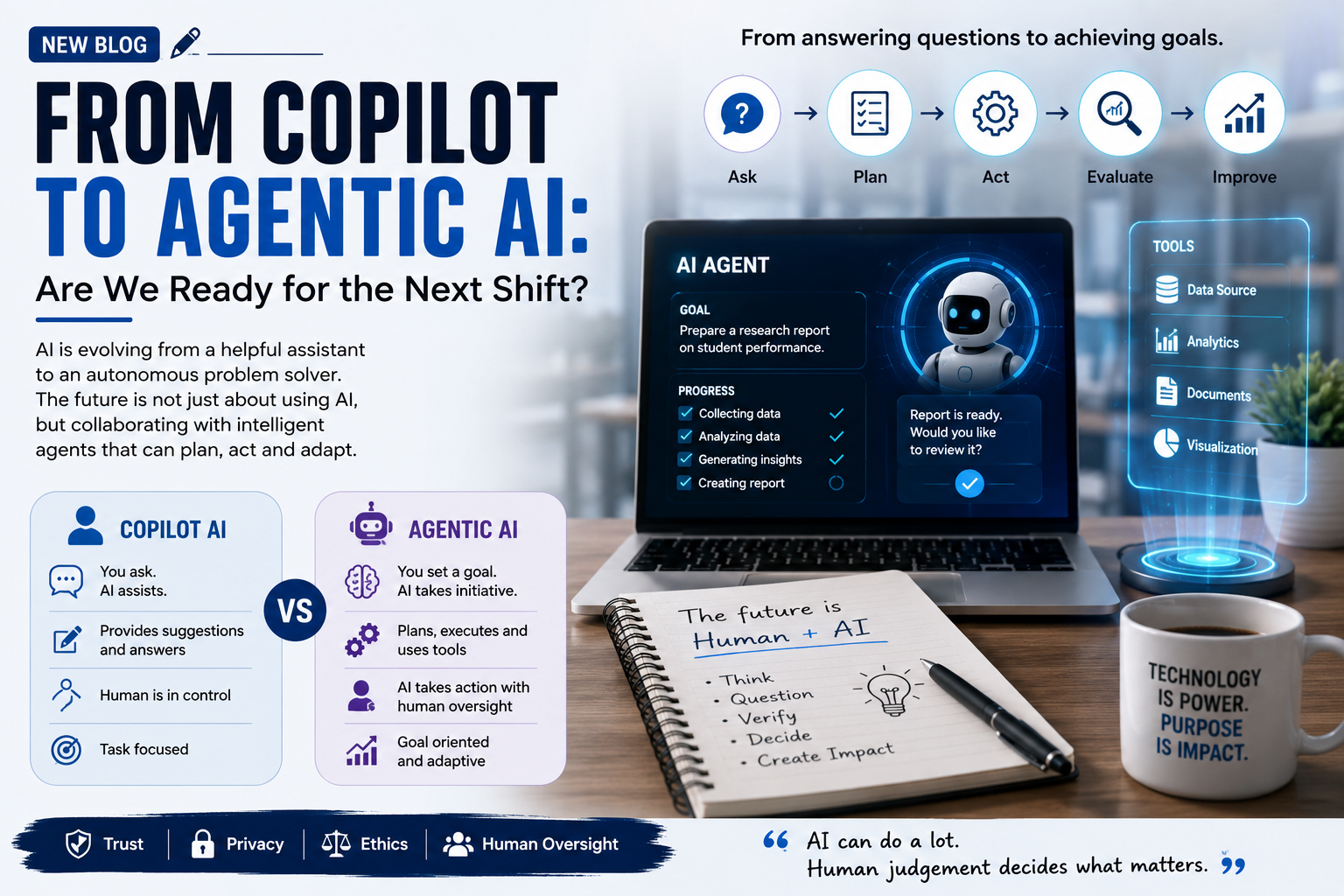
From Copilot to Agentic AI: Are We Ready for the Next Shift?
Artificial Intelligence has quietly changed the way we work.A few years ago, we were excited when AI could answer a question, generate a paragraph, write some code or create an image.
Then came the era of AI Copilots.
A Copilot doesn’t necessarily do everything for us. Instead, it works alongside us. It helps us write, analyse, code, summarise, brainstorm and make decisions.
The idea is simple:
You work. AI assists. You remain in control.
But something interesting is happening now.AI is gradually moving from being a copilot to becoming an agent.
From answering to doing
Think about the difference.You ask an AI Copilot:
“Create a report from this data.”
It may help you analyse the data and prepare the report.
An AI agent moves a step further.
It could potentially understand the objective, decide what steps are required, use different tools, work with data, perform tasks and return the completed result.That is a significant change.We are moving from:
Ask → Answer
towards:
Goal → Plan → Act → Evaluate → Improve
And this is where Agentic AI becomes particularly interesting.
But should we give AI more control?
This is where I think we need to slow down.Technology often develops faster than our ability to understand its consequences.Giving AI the ability to perform actions is very different from simply asking it a question.If an AI system can access information, make decisions, use software or trigger actions, then questions of trust, privacy, security, accountability and human oversight become extremely important.
We should not be impressed simply because an AI system can do more.We should ask:
Should it do it?That may become one of the most important questions in the age of Agentic AI.
What does this mean for students?As a teacher, this is perhaps the part that interests me the most.
Students are growing up in a world where AI can write code, explain concepts, generate presentations and assist with research.So what should students learn?
I don’t think the answer is simply more technology.
Students need to learn how to think, question, verify, communicate and solve problems.
Knowing how to use AI is becoming important.But knowing when not to trust AI may become equally important.A student who can ask AI to write a program is useful.A student who understands the problem, evaluates the generated solution, identifies its limitations and improves it is far more valuable.
Copilot is not the destination
For me, Copilot and Agentic AI are not about replacing human thinking.They are about changing the relationship between humans and technology.The real opportunity is not:
Human vs. AI
It is:
Human + AI
The future professional may not be the person who knows everything.It may be the person who knows what to ask, what to verify, what to delegate and what to decide personally.That is a very different skill set.
The next generation needs more than AI skills
As educators, researchers and technology professionals, we have an important responsibility.We should teach students how to use AI—but also how to think independently when AI is wrong.We should encourage experimentation—but also responsibility.
We should introduce new technologies—but never forget the human purpose behind them.Because ultimately, technology is only as valuable as the problems it helps us solve.Copilot may help us work faster.Agentic AI may help us work differently.
But human judgement will determine whether we use that power wisely.And perhaps that is the real conversation we need to have about AI.Not “What can AI do?”But:“What should we ask AI to do—and what should remain uniquely human?”That question may matter more than the technology itself.