
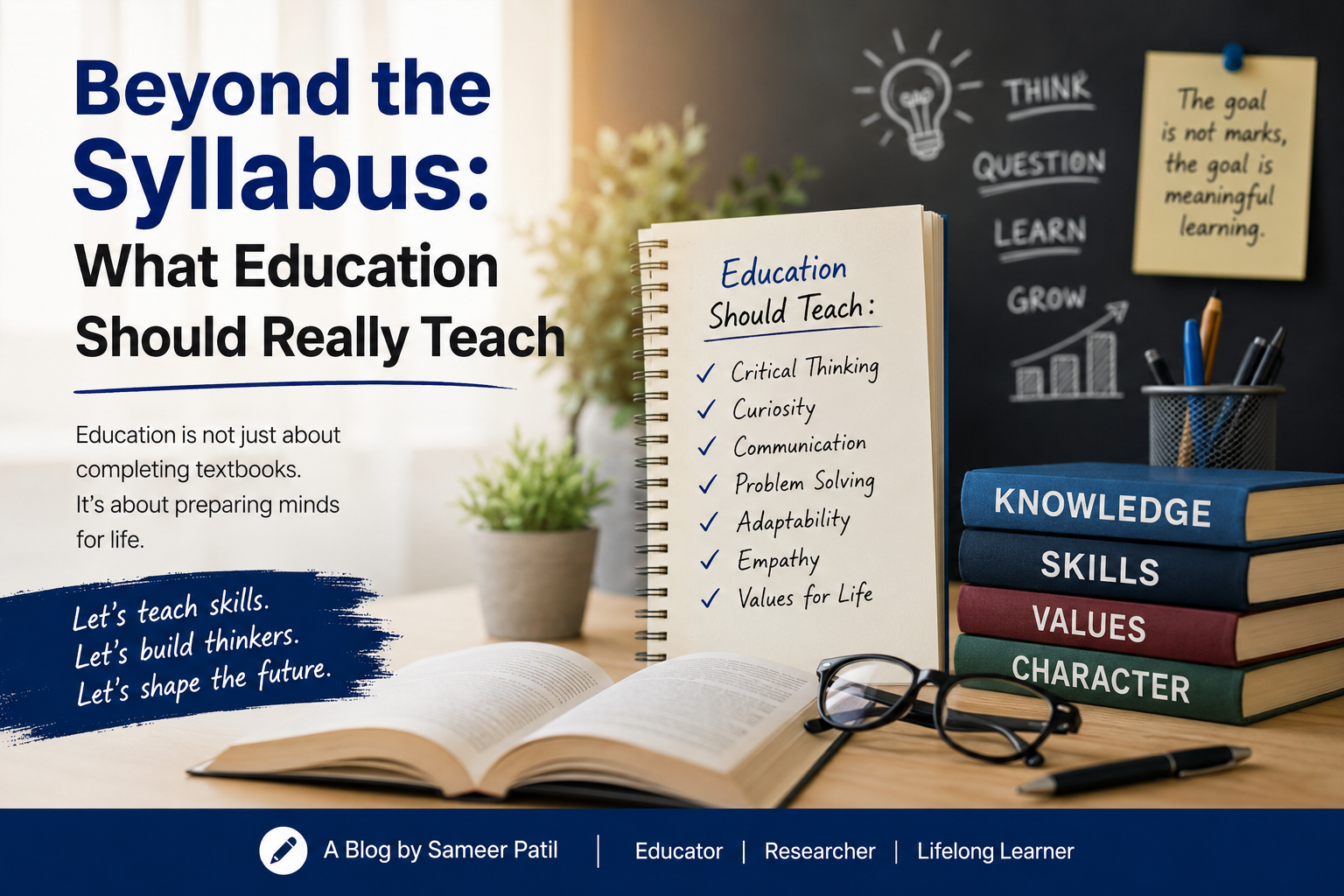
Beyond the Syllabus: What Education Should Really Teach
For many years, I have stood in classrooms, taught subjects, conducted examinations, evaluated assignments, and watched students move from one academic year to another.
We often measure education through marks.
A student gets 90%.
Another gets 75%.
Someone struggles to clear an examination.
But sometimes I find myself asking a simple question:
Are marks really telling us how prepared a student is for life?
The syllabus tells us what students need to learn.
But education should also help them understand how to learn, how to think, how to communicate, how to handle failure, and how to make decisions when there is no textbook to provide the answer.
That is where education goes beyond the syllabus.
The syllabus gives knowledge. Education should build thinking.
A student can remember a definition today and forget it after the examination.
But if we teach that student how to ask questions, analyse a situation, find information, and think independently, that learning can stay with them for years.
In today’s world, information is everywhere.
Students can search for an answer within seconds. AI tools can generate explanations, summaries, presentations, and even code.
So the question is no longer simply:
“Can you find the answer?”
The more important question is:
“Can you understand whether the answer is right?”
This is why critical thinking has become one of the most important skills education can develop.
Education should teach students to be curious
Sometimes, classrooms become focused on completing the syllabus.
We have chapters to finish.
Assignments to submit.
Examinations to conduct.
In this process, curiosity can easily get lost.
A student asks an unusual question, and sometimes our first reaction is, “That is not in the syllabus.”
But perhaps that is exactly the question we should encourage.
Curiosity is the beginning of learning.
A student who asks why is already taking the first step towards deeper understanding.
I believe a good classroom should not only provide answers. It should also create the confidence to ask better questions.
Teach students how to learn—not only what to learn
Technology and knowledge are changing faster than our textbooks.
What a student learns today may need to be updated tomorrow.
This is particularly visible in areas such as technology, data science, artificial intelligence, business, and digital transformation.
Therefore, education cannot simply prepare students for their first job.
It must prepare them for continuous learning.
Students should leave college knowing:
How to learn something they have never studied before
How to find reliable information
How to use technology responsibly
How to solve unfamiliar problems
How to learn from mistakes
How to adapt when circumstances change
The ability to learn may be more valuable than any single technical skill.
Failure should not be treated as the end
One thing I have observed over the years is that many students are afraid of making mistakes.
They worry about giving the wrong answer.
They hesitate to ask questions.
They sometimes prefer silence because they are afraid that others may judge them.
But learning without mistakes is almost impossible.
We should create classrooms where students understand that a wrong answer is not always a failure; sometimes it is the beginning of a better question.
Students need to experience failure in a safe environment.
Let them try.
Let them make mistakes.
Let them analyse what went wrong.
And most importantly, let them try again.
Because outside the classroom, life does not always give us a second chance—but it often gives us an opportunity to learn and improve.
Communication matters as much as knowledge
A student may have excellent technical knowledge but struggle to explain an idea.
Another may have a great solution but lack the confidence to present it.
In the workplace and in life, knowledge becomes valuable when we can communicate it.
Students need opportunities to:
Speak. Listen. Write. Present. Discuss. Collaborate.
These are not “extra” skills.
They are part of education.
A good idea that cannot be communicated may never get the opportunity it deserves.
Teach students to work with people
Education often focuses on individual performance.
But professional life is rarely an individual journey.
Students will work with people who think differently, communicate differently, and come from different backgrounds.
They will disagree.
They will negotiate.
They will collaborate.
They will sometimes have to lead, and sometimes they will have to follow.
Therefore, teamwork, empathy, respect, and emotional intelligence deserve a place in education.
A successful professional is not simply someone who knows a lot.
It is someone who can work effectively with others.
Technology should support learning—not replace thinking
As an educator working with technology and data, I strongly believe that technology has an important role in education.
AI can help students explore ideas.
Data can help teachers understand learning patterns.
Digital platforms can make learning more accessible.
But technology should never remove the student’s responsibility to think.
If a student uses AI to understand a difficult concept, that can be meaningful learning.
If the student simply copies an AI-generated answer without understanding it, very little learning has happened.
The goal should not be to teach students how to depend on technology.
The goal should be to teach them how to use technology intelligently, ethically, and responsibly.
Education should also teach life
There are things that no examination can properly measure.
How do you handle rejection?
How do you manage your time?
How do you deal with stress?
How do you make a difficult decision?
How do you respond when someone disagrees with you?
How do you manage money?
How do you behave when nobody is watching?
These are also lessons for life.
Perhaps education should create more opportunities for students to discuss such questions.
Because eventually, students will leave the classroom.
And life will become their biggest examination.
From marks to meaningful learning
I am not suggesting that examinations and academic performance are unimportant.
They have their place.
But marks should be one indicator of learning, not the definition of learning.
When a student graduates, I hope we can ask more than:
“What percentage did you score?”
We should also be able to ask:
Can you think independently?
Can you solve problems?
Can you communicate clearly?
Can you work with others?
Can you learn new things?
Can you adapt to change?
Can you use technology responsibly?
Can you make thoughtful decisions?
Can you keep learning even when nobody is teaching you?
These questions tell us much more about readiness for the real world.
What should education really teach?
If I had to put it simply, I would say:
The syllabus should teach students what to know.
Education should teach them how to think.
Experience should teach them how to apply it.
And life should teach them why it matters.
As educators, perhaps our greatest responsibility is not to fill students with information.
It is to help them become curious enough to keep learning, confident enough to ask questions, resilient enough to face failure, and thoughtful enough to use their knowledge wisely.
Because one day, our students will forget many of the chapters we taught.
But hopefully, they will remember how we encouraged them to think.
And perhaps that is the real measure of education.
Beyond the syllabus, we are not just preparing students for an examination.
We are preparing them for life.