
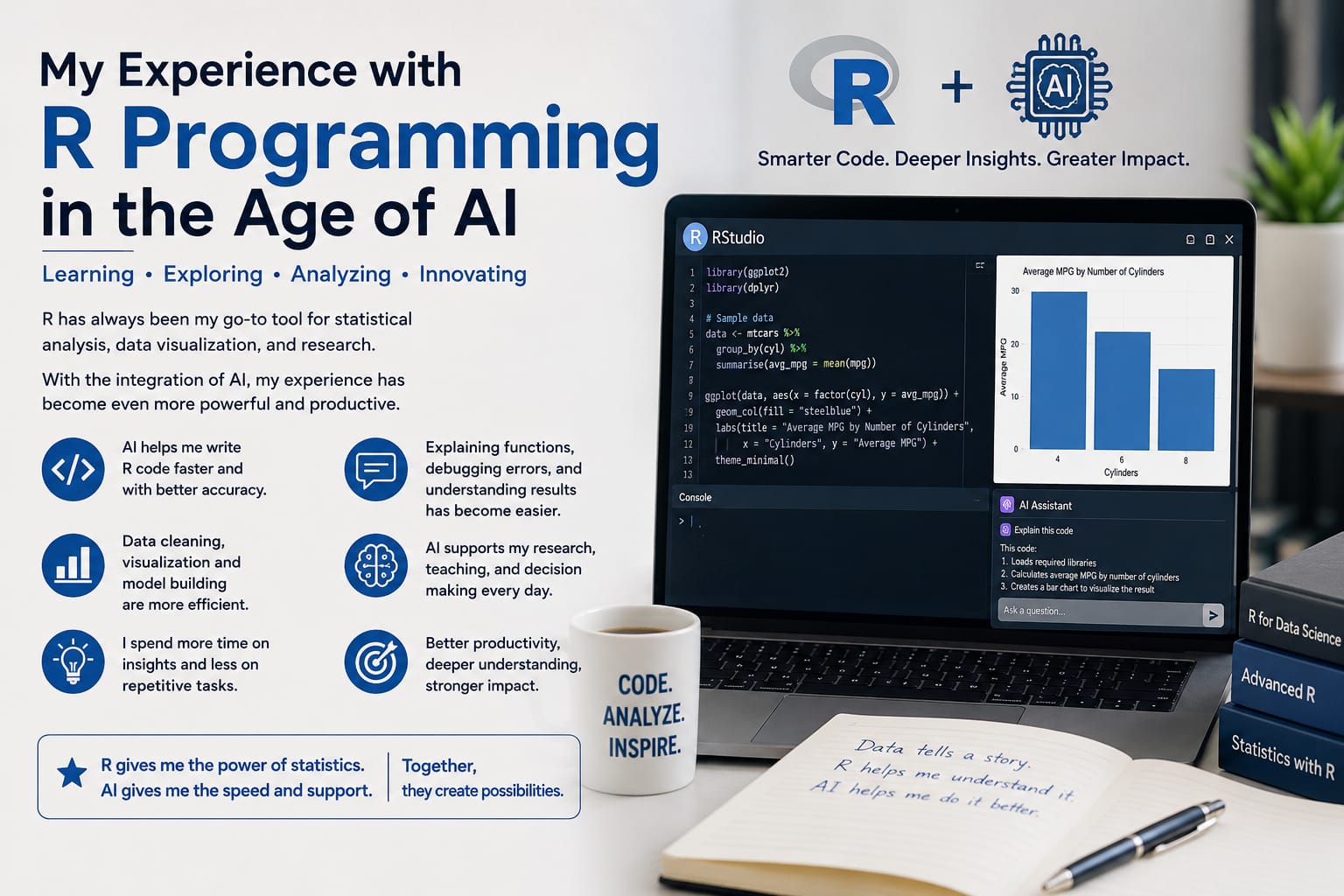
My Journey with R Programming in the Age of AI
As an educator, researcher, and someone passionate about data analytics, I have always believed that learning never stops. Over the years, I have worked with different programming languages and analytical tools, but R has consistently been one of my favourites for statistical computing, data visualization, and research.
Recently, I started exploring how Artificial Intelligence (AI) can complement the R programming workflow. Like many others, I was curious to know whether AI would change the way we write code, analyze data, and conduct research. After spending time experimenting with AI-powered tools alongside R, I can confidently say that it has transformed the way I work—not by replacing my skills,but by enhancing them.
One of the first things I noticed was how much time AI saves during development. Whether I need help writing a function, debugging an error, cleaning a dataset, or generating a visualization using ggplot2, AI acts like a knowledgeable assistant that is available whenever I need it. Instead of spending hours searching documentation or forums, I can focus more on understanding the problem and interpreting the results.
As a researcher, I find this particularly valuable. Research is not just about writing code; it is about asking the right questions, selecting the correct statistical methods, validating findings, and presenting meaningful conclusions. AI helps reduce the time spent on repetitive tasks, allowing me to devote more attention to critical thinking and decision-making.
Teaching has also become more engaging. When students encounter errors or struggle with R syntax, AI enables them to understand concepts more quickly. However, I always remind my students that AI should be viewed as a learning companion rather than a shortcut. The real value lies in understanding why the code works, not simply copying and pasting it.
One important realization from my experience is that R itself has not changed—our way of working with R has evolved. The language remains as powerful as ever for statistical analysis, predictive modelling, machine learning, and data visualization. What has changed is that AI now helps us become more productive, efficient, and confident in using these capabilities.
As technology continues to evolve, I believe that professionals who combine strong analytical skills with AI-assisted tools will be better prepared for the future. Programming is no longer just about writing code—it is about solving problems, extracting insights from data, and making informed decisions.
My journey with R and AI is still ongoing, and every day brings something new to learn. That is what excites me the most. Technology will continue to evolve, but curiosity, continuous learning, and the willingness to adapt will always remain our greatest strengths.
I look forward to exploring more possibilities where R and AI work together to make research, teaching, and data analytics more impactful. If you are learning R or working in data science, I encourage you to embrace AI—not as a replacement for your expertise, but as a partner that helps you learn faster, think deeper, and innovate with confidence.
What has your experience been with R and AI? I would love to hear your thoughts and learn from your journey as well.