
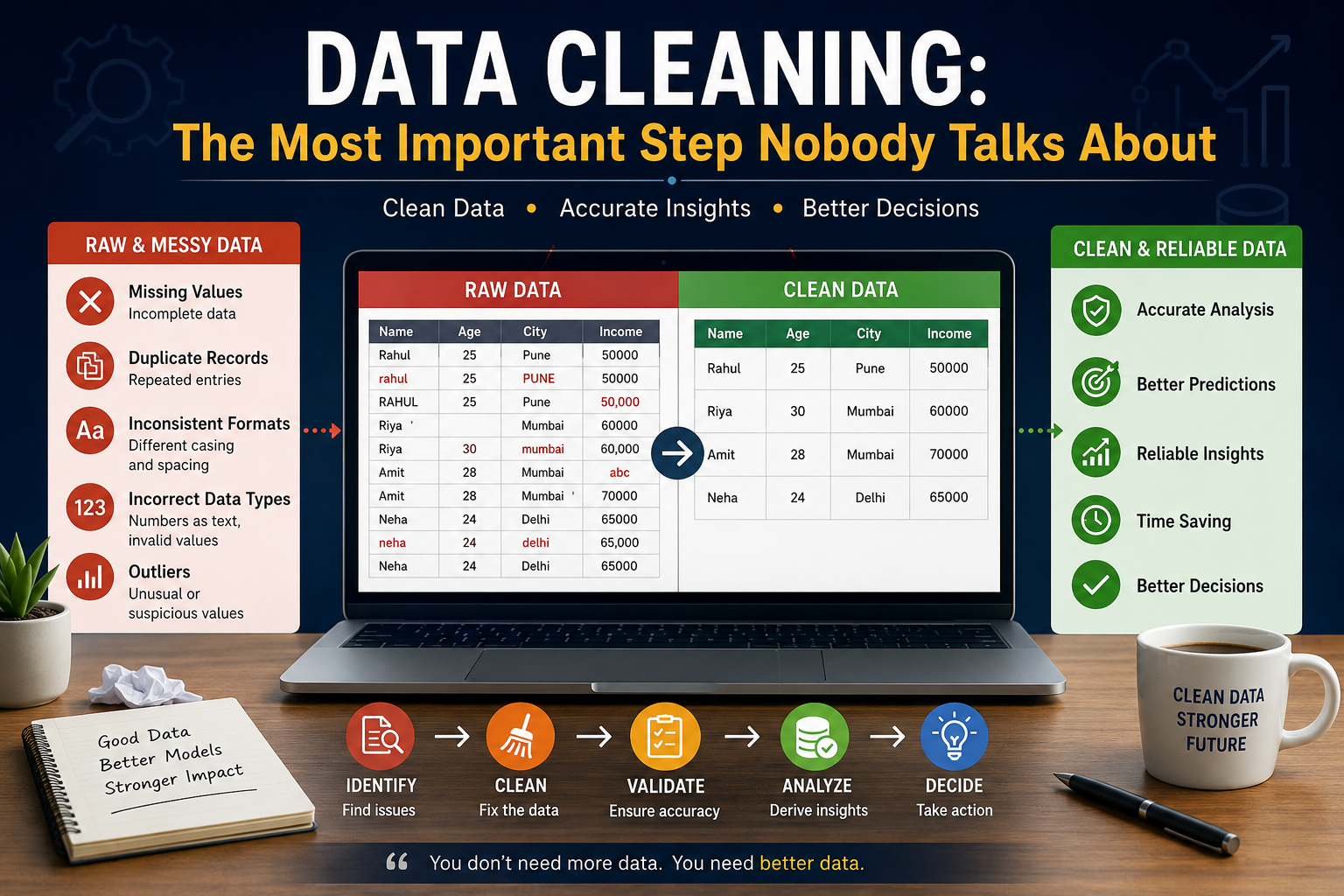
Data Cleaning: The Most Important Step Nobody Talks About
“Everyone wants to build intelligent AI models. Very few people realize that intelligence begins with clean data.”
When we hear terms like Artificial Intelligence, Machine Learning, or Data Science, our minds immediately jump to powerful algorithms, predictive models, and futuristic technologies. We often celebrate the final outcome—a model that predicts customer behavior, identifies diseases, or recommends the perfect movie.
But there’s an important part of the journey that rarely makes headlines.
It’s called data cleaning.
It isn’t glamorous. It doesn’t involve complex mathematics or advanced AI models. Yet, it is one of the most valuable skills every data professional should master. In fact, the success of any analytics or AI project often depends more on the quality of the data than on the sophistication of the algorithm.
Simply put, clean data creates trustworthy insights.
Why Data Cleaning Deserves More Attention
Imagine you’re baking a cake.
You buy the finest ingredients, use the latest kitchen equipment, and carefully follow every step of the recipe. But what if the flour is stale or the sugar has been mixed with salt?
No matter how skilled you are, the final result won’t meet expectations.
Working with data is no different.
No machine learning model—not even the most advanced one—can consistently produce reliable results if the underlying data is incomplete, inaccurate, or inconsistent.
That’s why experienced data scientists often repeat a simple but powerful phrase:
“Garbage in, garbage out.”
If poor-quality data goes into your system, poor-quality decisions will come out.
What Exactly Is Data Cleaning?
Data cleaning is the process of preparing raw data so it becomes accurate, consistent, complete, and ready for analysis.
Think of it as giving your data a health check.
During this process, you identify and fix problems such as:
- Missing information
- Duplicate records
- Typographical mistakes
- Inconsistent formats
- Incorrect values
- Irrelevant data
- Unusual or suspicious entries
The objective isn’t just to make data look neat. It’s to ensure that every decision made from that data is based on facts you can trust.
A Lesson Every Beginner Learns
When students begin learning Data Science, they’re usually excited to build machine learning models.
The first question is often:
“Which algorithm should I use?”
Interestingly, experienced professionals ask a different question:
“How clean is your data?”
That single question often determines whether a project succeeds or struggles.
A beautifully designed model trained on poor-quality data will almost always perform worse than a simple model trained on clean, reliable information.
A Real-Life Example
Imagine a college wants to predict which students may need additional academic support.
The dataset contains attendance records, internal assessment marks, and assignment scores.
At first glance, everything seems fine.
But a closer look reveals several issues:
- Some students appear more than once.
- Attendance values are missing for several records.
- Names are entered differently, such as “Rahul”, “RAHUL”, and “Rahul Kumar”.
- Marks have been entered using different grading formats.
If these problems aren’t addressed before building the prediction model, the results may be misleading. Students who genuinely need support could be overlooked, while others may be incorrectly identified.
This is why data cleaning isn’t just a technical task—it has real-world consequences.
Common Data Problems You Will Encounter
No dataset is perfect. Whether you’re working in education, healthcare, finance, or business, you’ll likely encounter familiar challenges.
Missing Values
Sometimes information simply isn’t available.
A customer’s age may be blank, a student’s attendance may be missing, or a survey participant may skip a question.
These gaps need thoughtful handling rather than being ignored.
Duplicate Records
The same person or transaction may appear multiple times.
If duplicates remain, reports become inaccurate and machine learning models may learn the wrong patterns.
Inconsistent Formatting
People rarely enter data in exactly the same way.
One person writes “Goa”, another writes “GOA”, while someone else types “goa”.
Although they refer to the same place, a computer may treat them as completely different values.
Incorrect Data Types
Dates, numbers, and text are often stored in inconsistent formats.
These seemingly small issues can lead to major processing errors later.
Outliers
Occasionally, you’ll find values that simply don’t make sense.
For example, if a student studies 5 hours per day on average, an entry showing 150 study hours deserves investigation before it’s accepted as truth.
Data Cleaning Is an Investment, Not a Delay
Many people assume data cleaning slows down a project.
The opposite is usually true.
Spending extra time preparing your data saves countless hours later by reducing errors, improving model accuracy, and increasing confidence in the final results.
It also builds trust among stakeholders who rely on your analysis to make important decisions.
ools That Make Data Cleaning Easier
Fortunately, you don’t need expensive software to improve data quality.
Professionals commonly use:
- Microsoft Excel for smaller datasets
- Python (Pandas) for automation and large-scale analysis
- SQL for database management
- Power BI (Power Query) for business reporting
- OpenRefine for messy textual data
- R for statistical analysis
The choice of tool matters less than the commitment to maintaining high-quality data.
The Human Side of Data Science
Data Science isn’t only about writing code.
It’s about understanding people, solving problems, and making informed decisions.
Every dataset represents real individuals, businesses, patients, students, or customers. When we clean data carefully, we’re respecting the stories behind those numbers.
Good data practices ultimately lead to better services, smarter decisions, and more meaningful outcomes.
Final Thoughts
Artificial Intelligence may be transforming the future, but its success still depends on something remarkably simple—clean, trustworthy data.
Before celebrating a highly accurate prediction or an impressive dashboard, ask yourself one important question:
“Can I trust the data behind it?”
Because in the world of Data Science, success doesn’t begin with algorithms.
It begins with quality.
And quality always begins with clean data.