
Beyond Accuracy: Why Conformal Prediction is the Future of Trustworthy AI
In Machine Learning, we often celebrate models with high accuracy. But in real-world applications, one question matters just as much:
“How confident is the model in its prediction?”
This is where Conformal Prediction comes into the picture.
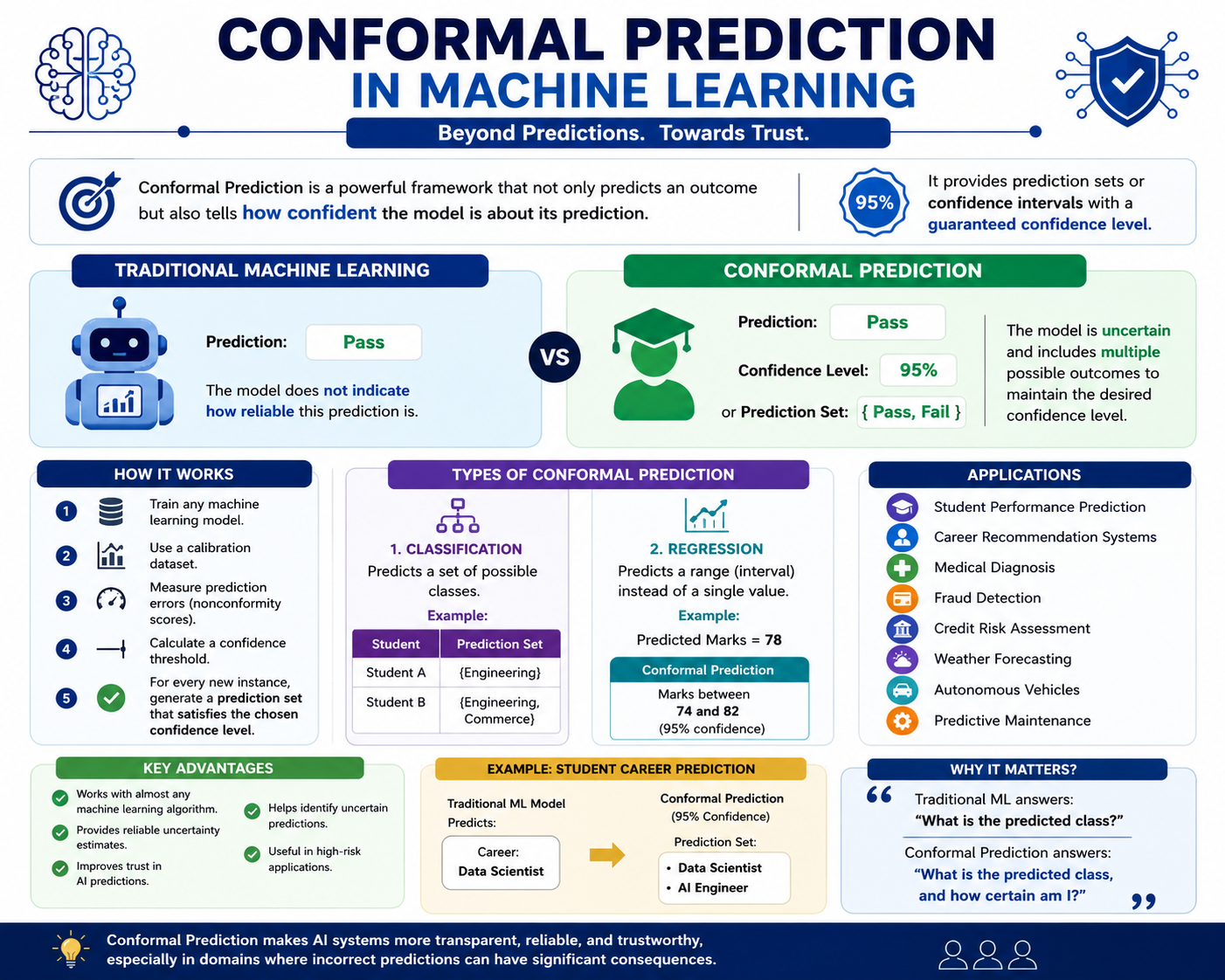
Unlike traditional machine learning models that provide a single prediction, Conformal Prediction quantifies uncertainty by generating prediction sets (for classification) or prediction intervals (for regression) with a user-defined confidence level, such as 95%.
Traditional Prediction
Student Career: Data Scientist
Conformal Prediction (95% Confidence)
Suitable Career Options:
- Data Scientist
- AI Engineer
Instead of forcing a single answer, the model communicates its uncertainty—making AI predictions more transparent, reliable, and actionable.
Why Conformal Prediction Matters
- Provides confidence-aware predictions
- Improves the reliability and trustworthiness of AI systems
- Works with most existing machine learning algorithms
- Helps identify uncertain predictions instead of overconfident ones
- Supports better decision-making in high-impact domains
Applications
- Student Performance Prediction
- Career Recommendation Systems
- Healthcare & Medical Diagnosis
- Fraud Detection
- Credit Risk Assessment
- Weather Forecasting
- Autonomous Driving
- Predictive Maintenance
As AI becomes an integral part of education, healthcare, finance, and industry, building models that not only predict accurately but also express their confidence is becoming essential.
The future of AI is not just about making predictions—it’s about making trustworthy predictions.
Are your machine learning models confident enough to support real-world decisions?
I’d love to hear your thoughts. How do you see uncertainty estimation shaping the next generation of AI systems?
The Problem with Traditional AI Confidence
Most machine learning algorithms return probabilities or confidence scores.
For example:
- Cat → 99%
- Dog → 1%
It is tempting to believe the model is almost certainly correct.
Unfortunately, these confidence values are often poorly calibrated.
Deep neural networks are well known for producing highly confident predictions even when they are completely wrong or when they encounter unfamiliar data. This phenomenon becomes especially dangerous in healthcare, finance, autonomous systems, and legal decision-making, where overconfidence can have serious consequences
Think Like a Human Expert
Imagine visiting an experienced doctor.
Sometimes the doctor says:
“I’m quite confident this is a viral infection.”
Other times, they may say:
“It could be one of three possible conditions. I recommend additional tests before making a final diagnosis.”
That uncertainty is not a weakness.
It reflects professional judgment.
Conformal Prediction enables AI systems to behave in a similar manner. Instead of pretending to know everything, the model openly communicates when uncertainty exists, allowing humans to make safer and more informed decisions.
So, What Exactly is Conformal Prediction?
Conformal Prediction is a statistical framework that sits on top of almost any machine learning model.
Rather than replacing your existing algorithm, it enhances it by attaching valid confidence guarantees to each prediction.
Instead of always returning a single answer, it may return:
- One highly confident prediction
- Multiple possible predictions
- A prediction interval
- A signal that the model is uncertain
This additional layer of information helps users understand not just what the model predicts, but how much trust should be placed in that prediction.
Conformal Prediction has gained significant momentum in recent years because it offers several practical advantages.
It is:
- Model-agnostic
- Distribution-free under standard assumptions
- Applicable to classification and regression
- Compatible with existing machine learning pipelines
- Supported by rigorous statistical guarantees
- Suitable for both traditional machine learning and modern deep learning systems
Unlike many uncertainty estimation techniques that require specialized architectures or retraining, Conformal Prediction often works as an additional calibration layer on top of an already trained model.
For years, machine learning competitions have celebrated models with the highest accuracy scores.
However, real-world AI demands more than leaderboard performance.
The future belongs to systems that know:
- when they are confident,
- when they are uncertain,
- and when they should ask for human assistance.
This shift represents a fundamental change in how we evaluate intelligent systems.
The question is no longer:
“How accurate is your model?”
Instead, we should ask:
“Can your model tell us when it might be wrong?”
That single capability can make the difference between an impressive AI demonstration and an AI system that people genuinely trust.
Artificial Intelligence should not merely produce predictions—it should provide predictions that people can rely on.
Conformal Prediction moves us closer to that vision by adding statistically sound measures of uncertainty to machine learning outputs.
As AI continues to expand into healthcare, finance, education, autonomous systems, cybersecurity, and other high-impact domains, trustworthy prediction will become just as important as accurate prediction.
The next generation of AI will not be defined solely by its intelligence.
It will be defined by its ability to communicate uncertainty, support informed decisions, and earn human trust.
#ArtificialIntelligence #MachineLearning #ConformalPrediction #TrustworthyAI #ExplainableAI #DataScience #PredictiveAnalytics #LearningAnalytics #CareerPrediction #StudentSuccess #AIResearch #EducationTechnology #Industry50 #ResponsibleAI