
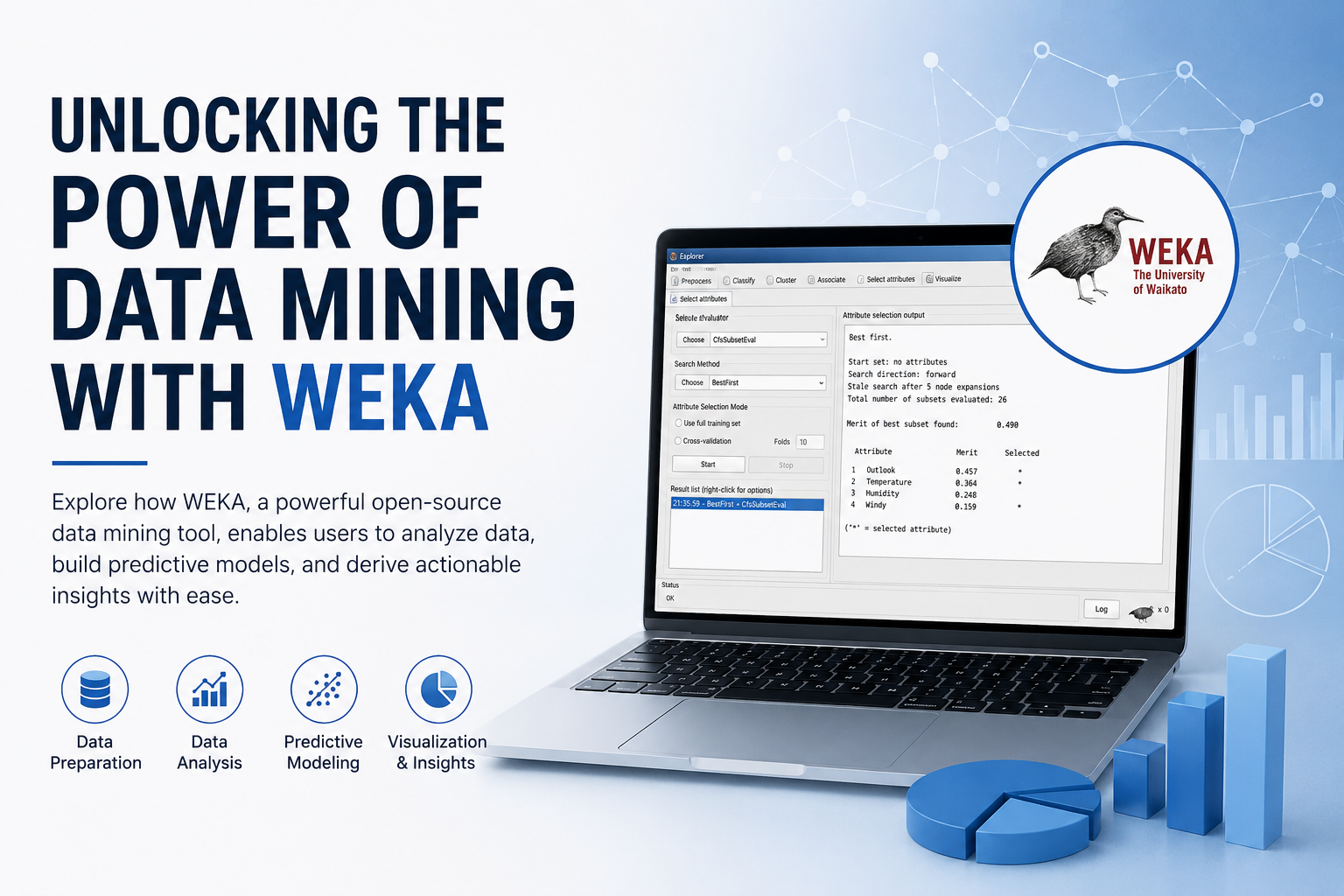
In the era of Artificial Intelligence and Big Data, organizations and educational institutions are increasingly relying on data-driven decision-making. The ability to extract meaningful patterns, predict outcomes, and analyze trends has become essential across industries. One powerful platform that continues to support researchers, academicians, and students in this journey is Weka.
Developed by the University of Waikato, Weka is an open-source data mining and machine learning software suite that provides a collection of algorithms and tools for data analysis and predictive modeling. Its intuitive graphical user interface makes it particularly valuable for beginners, while its extensive algorithm library supports advanced research and experimentation.
Why Weka Remains Relevant in the AI Era
Despite the emergence of modern AI frameworks, Weka continues to be widely used in academic and research environments because of its simplicity, reliability, and educational value. It allows users to focus on understanding machine learning concepts without requiring extensive programming knowledge.
Key capabilities of Weka include:
- Data preprocessing and cleaning
- Classification and prediction models
- Clustering techniques
- Association rule mining
- Regression analysis
- Data visualization and evaluation
These features enable researchers to efficiently transform raw datasets into actionable insights.
Popular Algorithms Available in Weka
Weka offers several widely used machine learning algorithms, including:
- Decision Tree (J48)
- Random Forest
- Naïve Bayes
- K-Nearest Neighbors (KNN)
- Support Vector Machine (SVM)
- Logistic Regression
Researchers can compare classifier performance, evaluate accuracy, and identify the most suitable model for their datasets using built-in evaluation metrics such as precision, recall, F-measure, and confusion matrices.
Applications in Educational Data Mining
Educational institutions are generating massive amounts of academic and administrative data. Tools like Weka can help institutions analyze this information effectively to improve strategic decision-making.
Some important applications include:
Student Performance Prediction
Machine learning models can identify patterns influencing academic success and help institutions provide timely academic support.
Dropout Risk Analysis
Predictive analytics can help detect students at risk of dropping out, enabling early intervention strategies.
Career Trend Analysis
Educational data can be analyzed to understand how academic performance influences career aspirations and professional choices.
Institutional Decision Support
Data-driven insights can assist educational administrators in improving resource allocation, curriculum planning, and student engagement.
Advantages of Using Weka for Research
One of the major strengths of Weka is its accessibility for academic research. Researchers can quickly test hypotheses, compare algorithms, and validate models using secondary datasets without building complex coding environments.
Benefits include:
Easy-to-use graphical interface
Open-source and freely available
Extensive machine learning algorithm support
Suitable for teaching and research
Effective for comparative classifier studies
Strong support for educational data mining projects
Final Thoughts
As Artificial Intelligence continues to transform industries, the importance of understanding data mining and machine learning tools is growing rapidly. Weka provides an excellent platform for students, researchers, and educators to explore predictive analytics and data-driven research in a practical and meaningful way.
For researchers working in Educational Data Mining, AI-driven management systems, or student performance analytics, Weka remains a valuable starting point for experimentation and innovation.
#Weka #DataMining #MachineLearning #ArtificialIntelligence #EducationalDataMining #DataScience #Research #AI #Analytics #HigherEducation #ComputerScience #PredictiveAnalytics #AcademicResearch